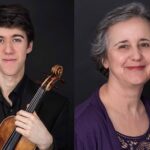
On Saturday 1 February the Dunwald Ensemble is playing at the Portsmouth Menuhin Room. It’s an exciting new musical collaboration, as Karen Kingsley explains.
How the Dunwald Ensemble came into being
Over the years Rob and I have played in a lot of wind and piano ensembles together, and we’ve worked with a few of our close friends. However, a little while ago our horn player has relocated to Hexham, which is a little bit of a long commute for rehearsals! So that group is lying dormant. I knew the names of all these other people and my partner Rob is the one who had direct contact with them, playing in orchestras, playing in other groups and so on.
We’ve been longing to set up a wind quintet, and the standard wind quintet of course is all wind instruments: rather than a piano, you would have a flute. I think they have plans for inviting a wonderful flautist along to join them at some point, but in the meantime, because I’ve been jumping up and down in the background saying, “wouldn’t it be lovely to do the Mozart piano and wind and the Beethoven piano and wind?”, they very kindly asked if I’d like to come along and just do a bit of playing one evening.
I think you very quickly know if a group is going to gel and that this gelling process, this chemistry, is more complicated the more people you have in a group. So it is all very well with me meeting with another singer, for instance, and finding out within 10 minutes that we’re feeling the music the same way and it’s going to be lovely and we’re in common with our phrases, and the kind of sound we like to make.
However within 5 or 10 minutes we realised that it was going to be a success. We were all very much interested in listening to each other, dovetailing and hearing what the other one wanted to say, both musically and literally speaking about the direction in which we felt the music should be going. And we’ve got people there whose personality seem to be fairly complementary. So we’re all different, but essentially when it comes to how we like our music, we seem to be very much the same. So that’s very exciting.
It’s in no way important that Rob B and I are somewhat the elder statesmen, because we’re just all feeling things the same way.
And if you’re having a good time, musically, you feel very young. You have a common goal and a common inspiration.
The first rehearsal is a bit like a blind date: you will have seen the people, but you’ve not had your musical conversation.
The Mozart and Beethoven quintets explored
My view is that the Mozart and the Beethoven are the obvious starting points simply because they are wonderful. The Mozart piano and wind and the Beethoven piano and wind have some very telling similarities, although obviously expressed completely differently.
Both of the works have three movements, both have an Allegro, having a slow section beforehand, Larghetto or Grave, expressed in a fairy stately and grandiose way: the use of the instruments makes a very big, sonorous colour, then you’ve either got little filigree details in between, or lyrical slurred fragments, I suppose, or in Beethoven’s case he goes for the pomp and circumstance of double dotted figures in unison. It’s basically a slow broad and grand movement going into quite a perky Allegro.
There’s lots of appreciation of what the wind instruments can do in the way of articulation. This is delightful to listen to, and a joy for the piano to hear how brilliant they are at slurs and staccato. And that inspires me to be as crisp as I can; it’s fun sorting out how I am going to do my ornaments.
The music is very nicely layered and breaks things down into interesting conversations between 2, 3 or the whole piece. Both of the Allegros have a really good sense of momentum and energy, and then you have your slow movement; it’s two in a bar in Mozart, it’s then three in a bar, but it’s all what I would call very gently flowing. Most of the time slightly persuaded forwards by the piano, having demi semi quaver figures. There are lots of very gentle broken chords over which the winds can weave their melodies and their conversations, and so on. It’s very beautiful and calming in both instances.
And then the third movement in both cases is a Rondo, so you get the chance to enjoy these. Again, there are very cheerful and springy kind of melodies and textures, obviously appearing and reappearing with different episodes in between. In both instances there’s a lovely bounce to the music, and they’re very cheerful.
Now obviously when it comes to the differences, I think this perhaps where people might fall into the same trap as all we musicians do at some time: we think Mozart Haydn, and Beethoven are much of a muchness because they’re all from the Classical period. And we know that they are incredibly different, both in the way they use melodies, in the way they use rests, and in the way they score things.
There are so many differences even with the ornamentation and the rhythms, and the feel is different. So again, I seem to like my food analogies: if you are going to the curry house, are you going to have a nice smooth and mellow chicken Korma, or are you going to have a lamb Achari with the nice pickily bite? They’re all very different in their flavours.
It’s a pity that Haydn didn’t write one as well for the sake of compare and contrast! The Mozart and the Beethoven just do show the individual characteristics of these composers. Mozart wrote the his quintet later, in his span of works then Beethoven, but Beethoven had already written a number of really fine piano sonatas and a string quartet or two, so he was in no way green.
Both composers were also very familiar with the horn: Mozart wrote 4 horn concertos and Beethoven wrote this amazing horn and pianist sonata quite early on, as well as good horn parts in the symphonies.
Barlow’s Soliloquy for Clarinet and Piano
We are doing another piece, the Soliloquy for Clarinet and Piano by David Barlow.
It’s quite a poignant story. David Barlow is no longer with us. A very good friend ours called Tony Smart earlier in his life had a dilemma that a lot of very talented people have: “Am I going down this route or am I going down another?” So basically he had one career choice or he could have tried to have become a professional clarinettist. He chose the other one. He kept clarinet playing in his life and was still very good, and he mixed in some fairly exalted musical circles in his younger years.
David Barlow handed this soliloquy over to Tony. It was a bit like someone handing over their accounts to the accountant at the end of the year. Rather than presenting books, you’ve got a carrier bag with a whole load of receipts inside, and the accountant has to make something of that. So poor Tony was given loads of scraps of manuscripts, if you like, and he made it his mission to turn it into a piece of music.
In its ideal performance form it would be clarinet and either a string orchestra or a string quartet. But Tony constructed a very idiomatic and lovely sounding piano part, and of course soliloquy implies a very thoughtful and both cerebral and emotional piece of music. Tony did a brilliant job.
He had actually planned for Rob and myself to put together a programme of some sort to celebrate his 80th birthday and we had a concert planned in which the soliloquy would have been played at Tony’s house to an invited audience of friends and family. Due to ill health he unfortunately had to postpone it. The idea was always at some point in 2025 to reschedule it. And it looked as though this at least would be a marvellous chance for him to hear basically what we’re playing on Saturday with a few other things or a couple of other things. However very sadly Tony passed away a couple of weeks ago.
So it is very poignant for us. We are going to dedicate the performance to him. It will mean a great deal to Rob and I that – even after his departure – we can at least finally get this piece out there and heard. It’s a fitting tribute to years or months or years of labour sorting things out these scraps of paper and making a piece of music of it. I know he had the skills to put together a very idiomatic and lovely sounding piano part, so that will be for us, a very personal and special part of the programme, and it will just be a change of texture before we return to the sonorities of piano and wind.
Finally, I’m so excited about playing in the Menuhin Room, to actually have that piano back. To think that it had just been languishing somewhere in a dark and dusty room for so many years! Congratulations to Andrew McVittie for his vision to bring it back to life and to establish such a successful series of concerts.
Review: the Dunwald Ensemble