St Peter’s, Petersfield, Saturday 29 March at 7.30pm
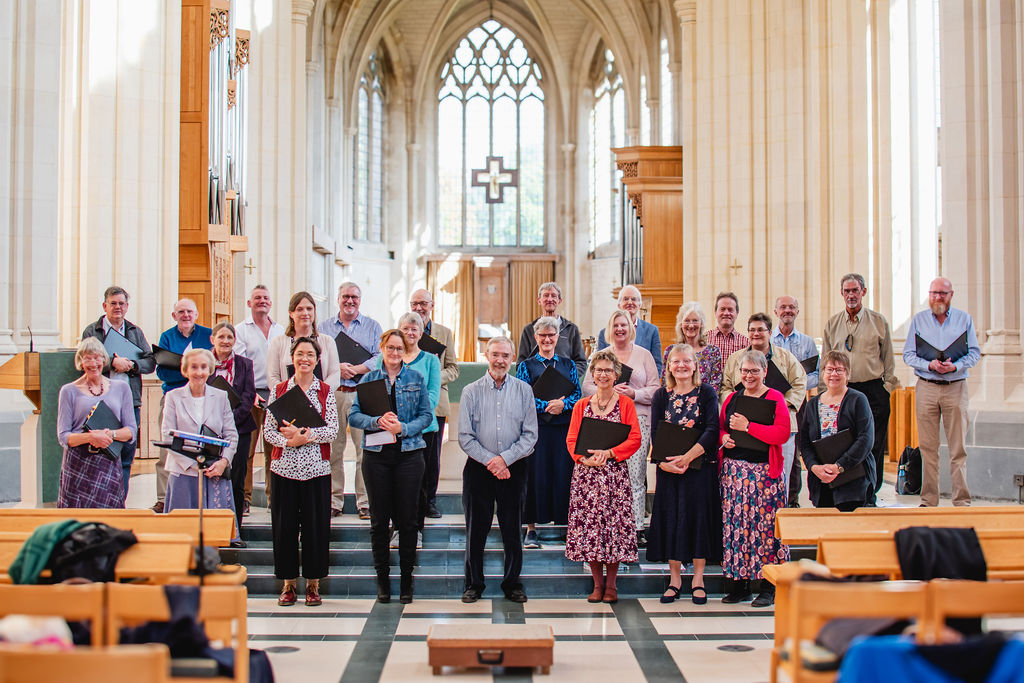
The Renaissance Choir, accompanied by organist Mark Dancer, continues its theme of nation-based concerts in this presentation of German music from four historical eras – Renaissance, Baroque, Classical and Romantic.
Following Martin Luther’s campaigning in the sixteenth century, the Reformation led to the majority of German churches putting more emphasis on the importance of singing by the congregation and of having an understanding of the services. Many of the great German composers such as Bach, Handel, Schütz and Beethoven followed in this Protestant tradition. The works we are singing in this concert all have a sense of a clear, direct link between the ordinary person and their God.
JS Bach (1685 – 1750) – ‘Komm, Jesu, Komm’ BWV 229
This well-known motet is a setting of a text by Paul Thymich who was professor at the Thomasschule where Bach worked and composed when he was in Leipzig. The text about feelings of a religious person looking towards to their death comes from the German Lutheran tradition where the love of Christ is so strong as wanting to sacrifice oneself to him. There is a lot of interplay between the two choirs, using devices such as falling paired notes to convey sighing, and the piece ends with a strong aria in the style of a chorale.
Ludwig van Beethoven (1770 – 1827) – Mass in C
This, the first of Beethoven’s masses, was written for Prince Esterhazy in 1807. It is in five separate undivided movements unlike some earlier masses such as Haydn’s . A feature of the work is the use of four soloists, used most often as a group together but with them emerging from the choir rather than having distinct sections. As usual with Beethoven, there are large dynamic contrasts.
The Kyrie starts almost naively; it is short, but it shows the strong dynamic contrasts which are to follow. The fast and lively Gloria has an alto solo ‘Qui tolis’ in F minor and a thrilling fugal ending back in the key of C.
The Credo, after a fast beginning, changes to an Adagio in Eb at ‘Et incarnato est’ , returning to Allegro in C with ‘Et ressurexit’. After contrasting passages for choir and soloists, the movement concludes with a thrilling section started by the sopranos at ‘Et vitam venturi saeculi’ which features running quavers.
The Sanctus is in a contrasting A major. It’s an unusual key to pair with C major. But A has a key signature of 3 sharps. The Sanctus begins with a motif of 3 notes, which is repeated 3 times. This represents the Holy Trinity: it was the convention across Europe for 200 years to reference the Trinity in this way. Bach was also a devotee of this device.
The Benedictus, an Allegretto in F, has the soloists mixing with choir at many points and finishes with a short Ossana in A. The Agnus Dei is an Andante starting in C minor in the unusual time signature of 12/8. This gives way to a powerful Allegro in C at ‘Dona nobis pacem’ with many dramatic sudden switches between piano and forte. The finale brings a reminder of the music from the opening of the Kyrie.
As this is a concert performance, we will actually be ending with the Gloria.
Anton Bruckner (1824-96) – Motets
The Austrian composer Bruckner is best known for his nine great symphonies, but he also wrote 40 motets spanning the whole of his composing career. These have great beauty with a unique combination of old-style declamation and thoroughly romantic sensibility, often making use of wide dynamic contrast. All are well-crafted and disciplined, demonstrating Bruckner’s years of study of old music. They are respected as some of the highest forms of Catholic church music and much loved by choirs today.
The choir will sing a selection of these motets, namely Ave Maria, Afferentur regi, Os Justi and Virga Jesse.
Hans Hassler (1562-1612) – Deus, Deus meus
Hassler was a leading German composer in the late 16th century. Born in Nuremberg, he went to study with Andrea Gabrieli in Venice in 1584, returning to be organist to the banker Octavian Fugger. Influenced by Lassus and the Venetian School, he wrote Latin polyphonic choral works but also hymns for the Lutheran liturgy. This piece, whose title translates as ‘My Lord and my God’ was an article of faith by St Thomas the Apostle, and is written for six voices. It has a short central section in triple time and some unusual syncopations in the last section.
Geoffrey Whittington