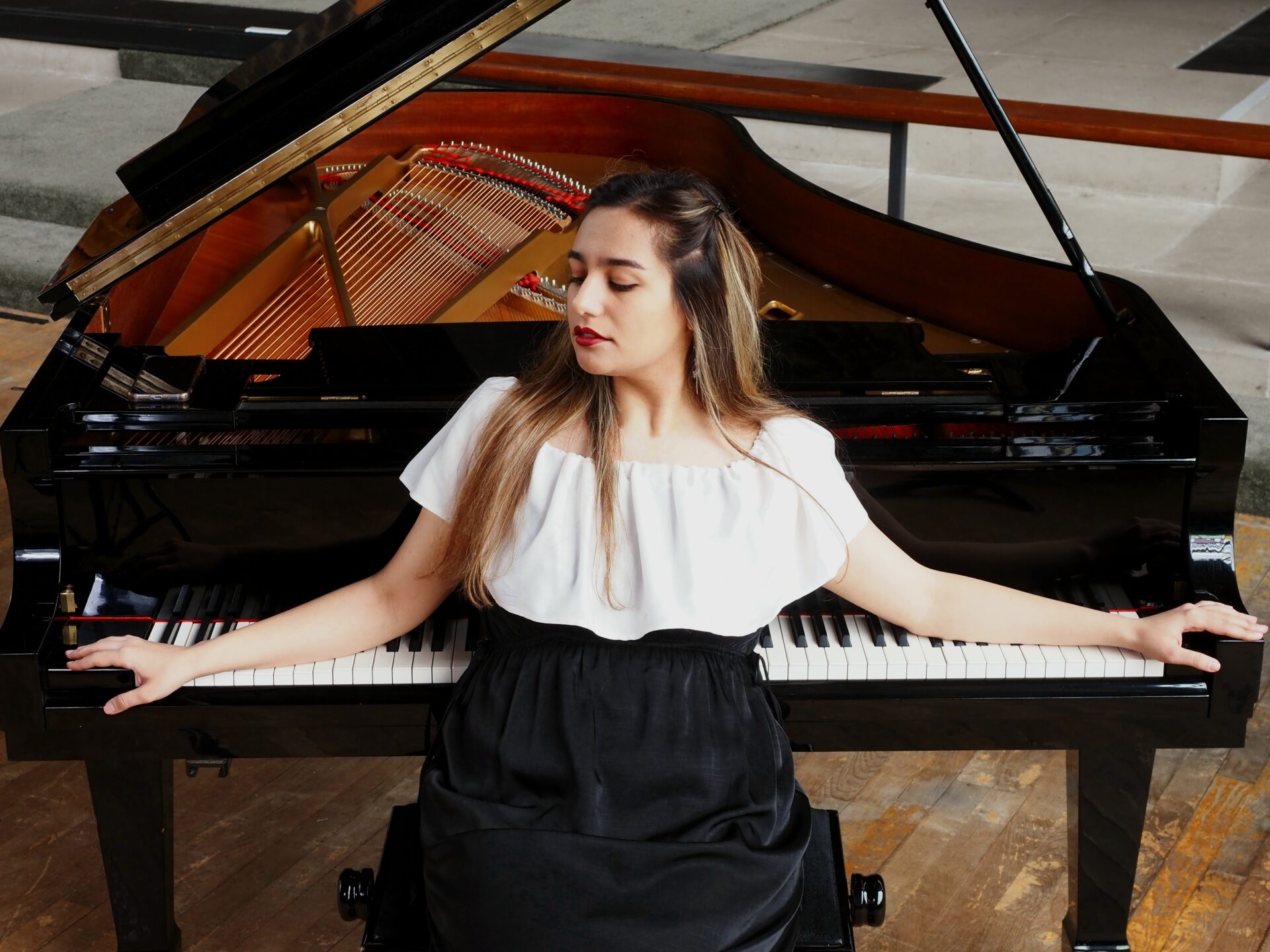
On Monday 16 June, Mahya Mahroomi presents East in the West: From Classical Roots to Persian Resonance at the Chapel of the Ascension, University of Chichester at 7pm.
What are you looking most forward to when performing at this concert?
This concert carries a special purpose: to present Persian music by Iranian composers alongside the classical repertoire. As an Iranian pianist, I feel deeply connected to this mission. I aim to share the beauty and depth of Persian melodies within classical forms, offering audiences something they may never have experienced before.
Recently, I had the opportunity to perform in A Celebration of Contemporary Iranian Music at City, University of London, where I showcased works by contemporary Iranian composers. Being part of this collective event was especially meaningful to me, as it was aiming to showcase Persian musical identity and highlight Iranian musicians whose works incorporate Persian musical elements and blend them with contemporary classical structures.
The positive feedback from that concert confirmed just how important and impactful it is to bring these unique voices to new ears and new stages. That experience strengthened my commitment to this mission, and I now look forward even more to continuing this journey—bringing Persian classical-inspired music to diverse audiences and giving composers a platform to be heard.
Who and/or what have been the most important influences on your musical career or interest in music?
My musical journey has been shaped by many experiences and individuals. From all those Thursdays spent attending piano lessons to the countless concerts I’ve participated in and watched, each step has left a mark. Among them, my teenage piano teacher had the most profound influence. He opened my eyes to the depth and beauty of classical music, introducing me to its history, technical foundations, schools of thought, and interpretative nuances.
Another key influence was during my undergraduate studies, when I took part in a concert series organized by my teacher, Mrs. Ashooghian. These performances taught me the value of dedication and professionalism—how to commit fully to the music and present it to an audience with integrity and passion.
What have been the greatest challenges of your musical career so far?
One of the greatest challenges I’ve encountered is engaging wider audiences—especially younger generations—with classical music. Despite its richness and emotional depth, classical music often remains underrepresented in mainstream culture. For those unfamiliar, it can seem distant or complex. A lack of institutional support and insufficient efforts to educate and introduce classical music to newer audiences can make it feel inaccessible. I believe more needs to be done—through funding, outreach, and education—to keep this treasure alive and thriving across generations.
What for you are the particular pleasures and challenges of collaborating with other musicians?
Collaboration is one of the most exciting aspects of my musical life. Working with other musicians brings fresh ideas, inspiration, and a beautiful exchange of interpretation. It’s a rewarding process of synchronising minds and artistic visions to bring out the best in a performance. However, coordinating logistics—scheduling rehearsals, aligning creative goals, and balancing different commitments—can be challenging. Still, the artistic reward is always worth the effort.
Are there any composers for whom you feel a particular affinity?
Bach holds a special place in my heart. His music feeds my love for discovering hidden layers within seemingly simple structures. I love how polyphony weaves together multiple voices, each adding its own depth and meaning.. Bach’s compositions are full of connections, dialogues, and contrasts waiting to be uncovered. Whether light and joyful or dark and spiritual, there is always a depth in his music that resonates with my emotional and intellectual curiosity.
Which works do you think you perform best? Why?
While I aim to give my best to every piece I perform, I have a particular affinity for the music of Bach and Chopin. I feel especially connected to Bach’s music—I’ve spent years refining my touch and interpretation to reveal its intricate details.
I’ve also been working closely with contemporary composers, premiering pieces written for and dedicated to me. These collaborations allow me to engage deeply with the music’s atmosphere, combining the composer’s intentions with my personal interpretation to create a unique performance.
Which performances are you most proud of?
I’m most proud of performances that receive meaningful feedback from the audience—those moments when I know the music has truly connected with people. I believe a performance becomes truly successful when it reflects full commitment to the music, the audience, and my own artistic standards. That authenticity is something I always strive for.
What are your most memorable concert experiences, either as a performer, composer, or listener?
One of the most unforgettable concerts I attended was Sir András Schiff’s performance at the Wigmore Hall in 2024. He performed The Art of Fugue by Bach, accompanied by a lecture that offered profound insight into the piece’s structure and meaning. His interpretation was deeply spiritual and enlightening—it helped me connect with the music in a completely new way and remains a key memory in my musical life.
What advice would you give to those who are considering a career in music?
Two words: patience and consistency. Music is a lifelong journey. As Rachmaninoff said, “Music is enough for a lifetime, but a lifetime is not enough for music.” To succeed, you must be resilient, dedicated, and willing to work—no matter the circumstances or how much time you can dedicate. Keep moving forward, even in small steps.
How would you define success as a musician?
For me, success is the moment when I successfully convey the message or emotional narrative I’ve worked hard to create. When I can guide my audience through a musical experience—sharing my interpretation and connecting on a deep level—that’s when I feel I’ve truly succeeded. It’s not just about technical skill, but about communication, presence, and impact.
What would you like to be doing in 5 years’ time?
In five years, I hope to be actively performing in festivals and concert platforms across the UK and Europe. I will continue premiering contemporary works, collaborating with composers, and sharing fresh music with audiences for the first time. That immediate connection—performing a piece that has just been created, bringing it to life—is something I find incredibly rewarding and wish to keep pursuing.
About Mahya
Mahya Mahroomi is an accomplished pianist, accompanist, and cultural advocate, currently based in the UK. She holds a Master’s degree in Music Performance from the University of Chichester. With a strong foundation in both Western classical music and contemporary Persian music, she has built a career that bridges cultures and celebrates originality.
She is a prize-winning performer, having received multiple awards, including 1st place in the Sonata and Romantic categories at the Coulsdon and Purley Festival in London (2025 and 2024, respectively), the Festival Cup Winner title, and 1st place at the 13th National Festival of Youth Music in Tehran. In recognition of her talent and contribution to music, she was awarded a £2000 bursary by the Chichester Music Society.
Her commitment to contemporary music includes recording and premiering original works by Iranian composers, and actively promoting contemporary Persian music through concerts that introduce Persian classical repertoire to broader audiences, including a lunchtime concert at City St George’s, University of London, in celebration of Contemporary Iranian Music and an upcoming concert in Festival of Chichester, East in the West: From Classical Roots to Persian Resonance.
Her performance history includes solo and ensemble recitals across the UK and Iran, such as lunchtime concerts at Wesley’s in London; appearances at the University of Chichester’s Chamber Music Extravaganza; and a collaboration concert with pianist Martino Tirimo. Participating in the orchestra, she recently performed Carmina Burana in a large-scale concert in Worthing, in partnership with West Sussex Music and Arun Choral Society.
In addition to her performing career, she is a visiting piano and keyboard teacher at West Sussex Music and an experienced private tutor, working with children and adults across a range of levels. She also serves as an accompanist at the University of Chichester and as an organist at St. Peter’s Church, Chichester.
Mahya’s social media links:
YouTube
Instagram
Facebook