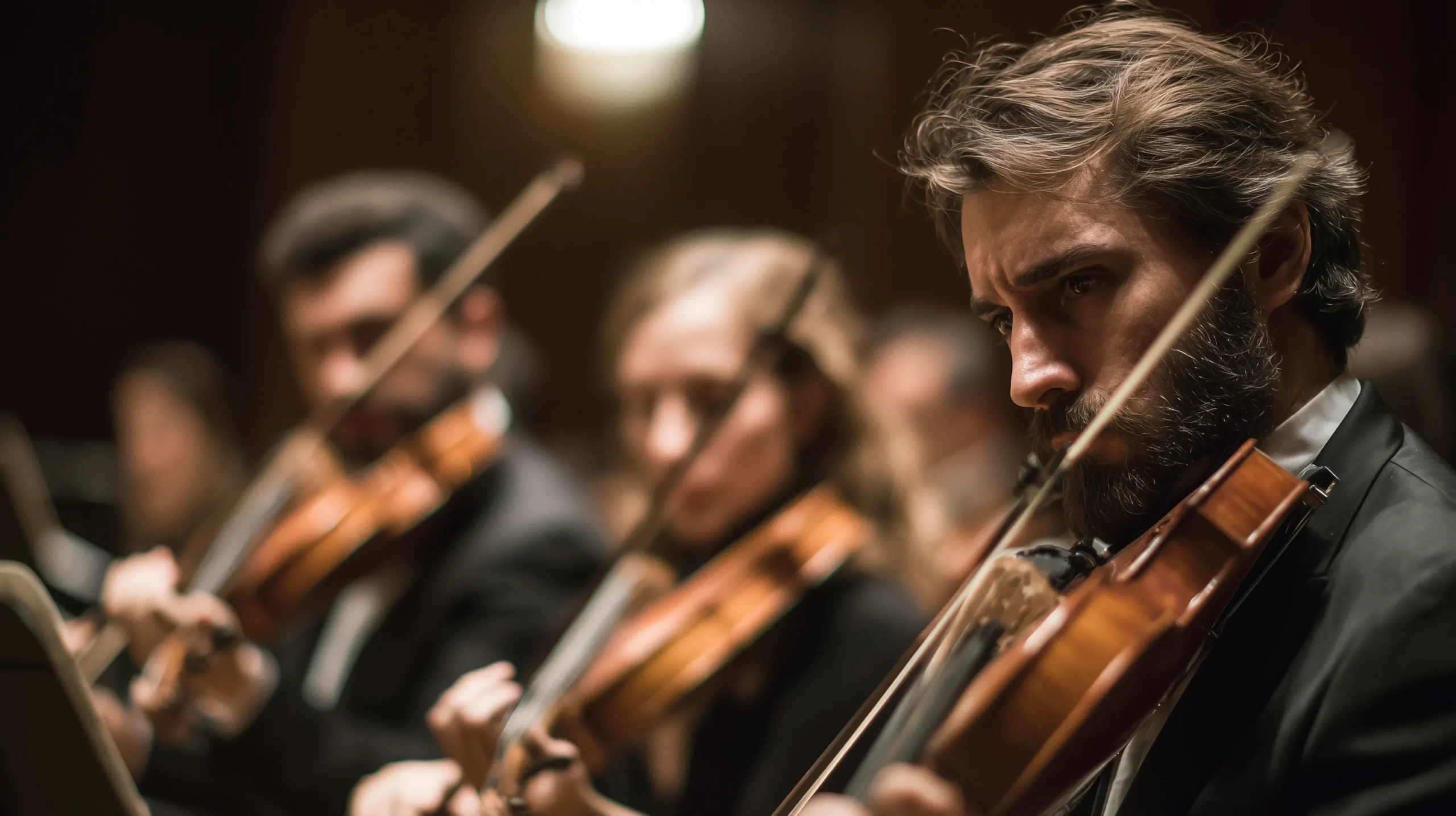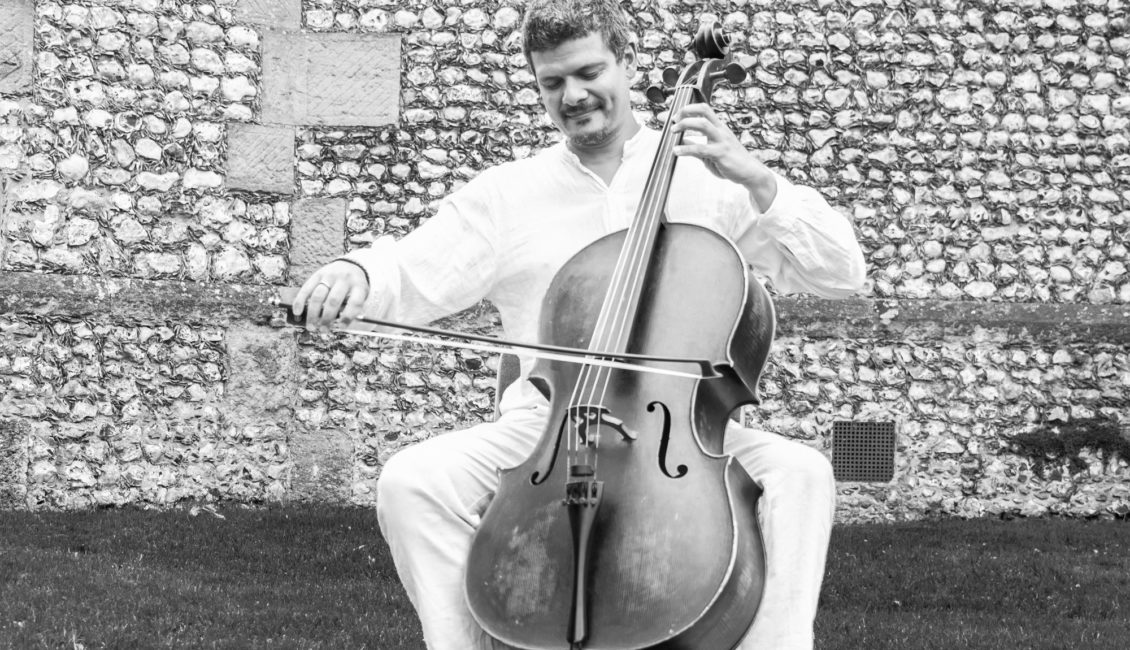
Pavlos Carvalho is playing in three events at the festival, all at St Paul’s Church in Chichester:
The Bach Cello Suites: Reflection, Catharsis, Jubilation – 28 June.
Rebetiki Serenata: Voices of Greece – 6 July.
Ensemble Reza: Celebrating Two Classical Greats! – 11 July.
Pavlos tells us more about himself.
What’s your “day job”?
I play with different groups, but the most regular group I play with is one called Ensemble Reza which has been going to Chichester regularly for the last few years. We’re a group that I set up just over 10 years ago with my wife Sara, who’s a fantastic musician and cellist, along with some other friends and with Hannah Carter, who’s our managing director.
We started as a string sextet in Haywards Heath at a time when we worked mainly in London, and by chance a lot of the players moved down to Sussex. And so I put together this group to do a concert here in Sussex, to see if we could get together and do concerts more regularly without having to be away from our families and to have to go up to London.
Our first concert around 10 years ago was Schubert’s string quintet. We’d meet up at home and have a glass of wine and food. And we thought, this is how a rehearsal should be done: how can we take this further? I spoke to Hannah, who by chance had just stopped being chairman of the Sussex Symphony Orchestra, and was looking to run something like this, and it all took off from there.
Hannah has been amazing, including looking for funding and pushing us forward. We now do a lot of outreach and education work; we have a series of concerts at the Hawth in Crawley, we do our evening recitals, and we do arrangements of everything that we enjoy that we haven’t been able to play as classical musicians. We scratch that itch because we have arrangers within the group: we do a lot of concerts where we’re arranging music from different countries, and present different alternative programmes. So it’s a really lovely group.
It’s been a magnet for musicians and for friends because there’s a big personal element to it. We don’t simply turn up to rehearse and do a job and leave: the group is something that we all really care about.
Ensemble Reza is the group that I spend most time with. There are other groups that I am involved with too: I run a charity called Rebetika Carnival, which is dedicated to promoting Greek and Asia Minor culture and doing outreach work using Greek music, which is very lyrical and very physical. It’s all based on dance and song as a tool for musical therapy. We run a biannual festival where we invite great musicians from all over the world who are Greek, and also collaborate with musicians here.
I get involved with anyone that wants music, if it’s something that sounds interesting – I don’t mind if the piece is something I’ve never done and which takes me out of my comfort zone.
What have been the influences on your musical career? How did you get to where you are now?
One of the biggest influences in my life was my father, who was a cellist and who introduced me to the instrument. He gave me a cello when I was a six year old and I have never looked back. Certain teachers have been amazing influences. Also friends, this group – the musicians I play with.
If I had to single out one person who’s been most influential to me, that’s my mother – that’s notwithstanding all the composers and all the incredible musicians I’ve had the luck to come in contact with. Sadly she passed away about 16 years ago and she wasn’t a musician at all: she was a classicist and a historian.
She was Greek but came to England. She loved the piano but never had the opportunity to learn it. She stopped working as a teacher and historian when I and my siblings were born and dedicated her life to looking after us children. When I was 12, she did a Master’s degree and then started working again.
I remember every time I used to walk into the kitchen where she’d be cooking or preparing food for us that there sat a massive chest of classical books. As a Greek she’d been reading these ever since she was born. These books – Euripides, Sophocles and the like – were a Shakespeare to her. She knew these texts back to front, and she was going over them again and again, making notes. Connecting things with modern life, going back to the same books again and again, narrating these stories to me with a passion and a dedication.
She was so dedicated to trying to get to the bottom of the stories: she could read the same things again and again, and never got bored with it all. She had the humility to know that she could never fully understand everything, but always tried to.
This was just the biggest inspiration and biggest lesson for me. Although I would never claim to be as deep in my search for the truth in music as she was with classics, this is what has driven and inspired me.
This informed my conscience about my attitude to “entertainment.” Nowadays it seems that people value the presentation over the substance. She was someone who was never acknowledged: she wasn’t a musician getting up there on the stage. No one I know had the knowledge and the approach that she had. And this is something I’ve valued so much. Hopefully I am doing my best to take this approach to music.
I have a particular love of Bach. I come back to the Festival of Chichester with a programme of Bach every year, and each time I come back to it I never feel quite competent enough, even though I’ve been playing his works all my life. It’s a constant search to try and do things differently (not necessarily better): that doesn’t take away from the satisfaction and the joy of playing it.
I cannot understand musicians getting bored of playing the same thing over and over again, because it’s really our responsibility to find something different in in the music that we play, even if we play it 1,000 times over. I love doing new things and going out of my comfort zone and doing things I don’t know, but I love even more going back to things that I know really well because everything always feels more natural the more you play it, and there’s always something else that you can find that you didn’t notice before.
What have been the greatest challenges of your musical career so far would you say?
Marrying the modern approach to promotion and marketing with not being swept away by market-led concerts: this is a constant conversation and conflict that I have. I really understand that it’s important to get bums on seats, but sometimes one can get too carried away with putting on what we think people want and not having the guts to try something a bit more risky, or even the respect for an audience to give them something that they might not like but have the right to have a taste of.
Sometimes we try to second-guess what an audience wants. And of course, we should be adventurous in not doing something mainstream or something that you know they are going to love. We have to value and respect our audience’s intelligence that they will at least take it or leave it. It’s important to offer new things to them which they might never want to hear it again; at least we are giving them that choice.
I find this increasingly challenging. I’m trying to bring classical music into people’s lives without dumbing it down and without selling it for something that isn’t that it’s not, by trying to make it look cool in the wrong kind of way. You know the music itself and the way you perform it is cool enough. It might bring people to it briefly, but then it’s a very short term vision.
By contrast I’m trying to promote this music in the right way, simply by doing it absolutely brilliantly and with an energy and a passion for it. I find it hard to marry this idea of always of trying to make classical music sexy in in its presentation, rather than just going there and doing it brilliantly and spending time working at the right things.
I prefer this to spending time being distracted by social media and the constant video streams that people seem to have to do. All that time you spend concerned about reading your Facebook feed and what everyone’s saying is time taken away from thinking about how you can do an interesting programme and how you can work at the art and the skill of music, which is something you can never get to the bottom of.
As we get older, it’s even more important to work more at this because our powers fade and we have less energy.
What are the particular pleasures and challenges of collaborating with other musicians?
There pleasures are on two levels. First of all, it’s about collaborating with fellow classical musicians, where we share the same language. With other musical genres, the approach to a rehearsal can be very different. Within classical music, the challenge is always finding people who not have different ideas but who understand that to play good music you have to turn up with strong ideas and strong principles, but also always willing to try and execute what the other person wants, even if it doesn’t agree with you.
So I think the challenge and the enjoyment for me is that when you work with other musicians, you’re always going to be presented with an idea that you hadn’t thought of, and that might be completely and extremely different from yours. What has kept our music alive for the last 200 years is new musicians always coming up with new ways of playing things and new ideas.
And what are the challenges? Being in a room with musicians who allow space for others to share their ideas without treading on them if you don’t agree with them because one always feels an insecurity. And sometimes when you’re faced with something new that you might find difficult, you might try and defend it by saying it’s wrong.
So it’s really a challenge to find musicians that have the humility to fall flat on the face and to be willing to try other people’s ideas, even if they don’t completely agree with them. And to have this space in the middle where you can put all these ideas.
Of course you want to bring your ideas to the party, but you also want to enable people to have the freedom to express their ideas without feeling afraid to do so.
Possibly the biggest challenge and joy is when you are bringing musicians from different genres together. This is something I’ve been doing a lot recently. I recently did a concert where I had to write arrangements with a beautiful album of Greek music, written for string quintet and a traditional Greek folk band. The Greek musicians learn this music all by ear – they don’t read a note of music. My job was to arrange it, which is scored. This is different from the classical approach.
But the common approach is that we want to make something beautiful and emotional and moving, and something that we enjoy at the end: this is the thread that goes guides us. The worry was that these Greek musicians might think that the “classical approach” would be rigid, when actually it does not have to be. It depends on the musicians.
But what was so beautiful about it is that in the even in the separate rehearsals, the classical musicians whom I work with were so respectful and so worried about being able to do what they needed to do for the Greek musicians, who themselves were a little bit nervous about playing. It was amazing to see these two groups of musicians coming together from a different genres. If people have the patience and the talent to want to adapt, then anything can work.
Similarly we are shortly putting on a concert consisting of a classical and a rock band. We’re doing 20 minutes of just classical music, then the classical group is just doing a rock piece, then the rock band is doing the rock music and a classical piece. And in the second half we’re collaborating and writing arrangements of both classical and rock pieces.
When you play with musicians from another genre, they introduce you to some amazing music that you didn’t previously listen to. I’ve now got playlists now on my Spotify that I haven’t listened to for the last 45 or years or so. And so you learn so much from opening yourself up to other musicians, even if it’s a kind of music that you don’t know. It simply opens up new worlds of people and sounds.
Are there any composers for whom you feel a particular affinity?
I’d say Bach. I don’t think Bach is necessarily what I play best: maybe more romantic music might come more naturally to me as a cellist – you can just dig in and forget about everything. And so maybe I play that kind of music better. But Bach is the one that really I live with on a daily basis.
It’s because with Bach there’s so much to uncover. As a cellist with these Suites – this kind of multi-polyphonic music written for one instrument where so much is not there but implied. It’s like a game and a jigsaw puzzle and a box of treasures that you’re digging into and always finding new gems. You are always trying to uncover what he’s really trying to make you make you hear. One is trying to analyse the mathematical games and its challenges. But ultimately it’s about how one chord relates to the other, and the beauty of this is abstract and it really moves me. You never get tired because the harmonies, the imagination, the development and the evolution of the harmony is so beautiful that you can just sit there at a piano and just play chords. It is just so gorgeous to listen to and go through on the most simple level.
Bach is the first memory I have of music while growing up: my father used to play it when I was a little boy. It’s the music that took brought me to the cello. His first Suite might be the most overplayed piece of all time, but again I never get tired of it. I could play it all day long, every day and never get bored. Because I play it more regularly than anything else, it’s there every day. Bach is the music I play most often, and the thing I’ll always come back to.
Is there anybody else you’d particularly like to highlight?
I do love Shostakovich and Beethoven – I came to Beethoven later in my career.
With Beethoven the first time I played the complete piano trios and complete cello sonatas. And this was really interesting because he wrote both these sets of pieces over the whole span of his life. And so it was like having a bird’s eye view of his life and development.
Although I do I love Mozart in that every single note is so perfect, almost untouchable and sublime, Beethoven is the music I can really relate to. With Beethoven what I love is that you feel and celebrate the imperfections of life. One moment it is really jagged and hard to listen to, but the next it us sublime, heavenly and tender…within the space of a few seconds of music. This unpredictability and constant change of mood feels much more of art reflecting life and one can relate to it, especially as you get older. I didn’t feel this when I was younger.
It’s just an instinctive feeling with Shostakovich. When you are playing the No.7 Leningrad Symphony, you hear this metallic military sound, the sarcasm and irony in Shostakovich’s music, paired with some of the most sublime music. It’s almost Rachmaninoff-sounding or jazzy music that really makes it makes your hair stand on end. I remember that as a young boy I had to write an English essay based on a piece of music. And I chose to write about Shostakovich Symphony No.5 and just writing about the desolation of a particular part of it. You know, it’s so graphic and powerful.
What advice would you give to those who are considering a career in music?
You can’t do it halfway. You have to just jump in with all feet: if you know 100% that this is what you want to do and you’re not going to be distracted from it, find the fun and grind in those moments where you’re not in the mood.
You know you have to do your technical work and your foundation work so that you can have the facility to express music in the way that you want, and then people will know that you can do it and might want to employ you. So you have not to be too calculating about it. Just know you want to do it and throw yourself into it 100% and do whatever it takes to the best you can be. Also turn up on time and turn up prepared.
How might you define success as a musician?
I think that you can define success in several ways. First of all, whatever you’re doing at whatever level, if you’re still able to make a living while doing it, then that’s successful, whether you’re teaching or performing. If people still are asking you to work for them and you’re still managing to get through life doing music in the way that you’re doing, I think this is a success. You don’t have to be at the Royal Albert Hall every day to be considered successful.
Then I think you can measure it if you’re managing financially – if you’ve managed to carve out a career and you can rely simply on making music to put bread on the table.
However I don’t think of myself as successful. My goal is to try to understand the next gig and to be better than before. You always set yourself these goals and then if you achieve them you realise that there are still more goals to achieve. You can’t measure yourself as successful simply because you’ve achieved something that you wanted to achieve, because there’s so much more to do and there’s so much more to learn.
But for me, the biggest success is at the level of the individual concert: do you feel fulfilled at the end of a concert, and have the people you’ve played for feel moved or fulfilled or enjoyed it in some kind of way? This this is the greatest measure of success for me as a musician. At the end of the concert, does someone come to you and say have they been moved by it in some way, or say that it’s reminded them of something, or that it’s moved them, or it’s made them feel happy or it’s made them cry a bit because it’s made them feel nostalgic for something?
If you come at the end of the concert and your audience has felt they’ve enjoyed what you’ve done, it’s moved them in some way and you’ve felt that you’ve enjoyed what you’ve what you’ve done despite all the doubts and the tightrope walking that comes with playing in a musical concert, then that makes for success. This is irrespective of what happened in your last concert or will come your next concert, because I think you know that this success is such a momentary thing. So you have to be kind to yourself and approach it in isolation, concert by concert.
What would you like to be doing in five years time? Much more of the same? Or if you got aspirations in other directions?
I do not want to sound ungrateful. I absolutely love music with a passion and I hope I’m still able to do it in five years’ time. But my thoughts have shifted to having a wider experience through music: I’ve learnt that you don’t squeeze the juice out of life by locking yourself in a room practising for 13 hours. You have to do this with practical real life experience. Otherwise it doesn’t really mean anything. You have to do it in the context of appreciating the world you live in.
I love languages and I love travelling. My dream in five years’ time is perhaps to do fewer concerts but to spend more time preparing for those so that I can absorb and dedicate more time to fewer concerts – to learn the music better, and to go on stage knowing it even better.
This will also allow you to have more time to travel, learn more languages and experience more people, to make more connections. If I can do that through music, great. But also it’s nice sometimes to leave the instrument behind. And just be there with your family. I just came back from 2 ½ weeks in Brazil with my two daughters and my wife. Last time I visited Brazil around Brazil 20 years ago. As a child, I used to go a bit more regularly, but I haven’t been for a long time. It was the first time I have been with my family and it was a life-changing experience.
You don’t want the situation arising when music or the slavery the job stops you experiencing beautiful things that life has to offer. You have to think, “maybe I’ve done that. Maybe now it’s time.” Because there’s a sell-by date on life and what one is able to achieve in life: physically and mentally you have to start trying to squeeze the juice out of life in other ways as well. That doesn’t undermine what you’ve done or what you are doing. It’s not a reflection on how passionate you are. I’ll never lose my passion or my love for music. But you know very well there are many ugly things happening in the world. We must not forget that there are so many beautiful things and only through travelling can we understand people and language and the psychologies of these other countries better.
So this is what I’d love to be doing in five years’ time – travelling more. And maybe with my family, if I can. My girls are getting older, so I’d like simply to be travelling more with the people that I love and seeing the world. This is a “forever thing” – as I was saying about Bach, you never get to the bottom of it and you can never see enough of the world.
A platform for younger musicians
As a postscript, while speaking about young people and the highlights for collaborations, one of the most amazing things for me was the first time I did a concert cello octet for the Reza and my eldest daughter joined us and played Bachianas Brasileiras. She’s a brilliant musician and it was the first time we did with all professional musicians: she came and played and it was incredible because we played this Bachianas, which is Brazilian music, which again I’ve grown up with. To have my daughter and my wife both playing was fantastic.
My daughter played because she’s a brilliant cellist. It is so good to be on stage and suddenly realise that you’ll be able to one play these concerts with your own daughter. And then my younger daughter, who loves musical theatre, came and joined us and she sang in a tango concert we just recently. We did an arrangement for a tango group, but it was a Greek tango, so she sang in Greek. And it was the first time she’d done that with us and that was just absolutely thrilling.
So it’s great suddenly to be able to provide a professional platform for young musicians and even better when those musicians are family. It’s so nice because very often we bandy about this word of being professional and everything, and sometimes one can forget that you can combine friends and professional family, and when all these elements come together, there’s nothing like it. You forget that you’re doing a professional concert and it feels like you are the luckiest people in the world because it’s like having a party on stage. I just wanted to mention that because we didn’t talk so much about young people and that was something recently that happened which was really amazing.
About Pavlos
Pavlos Carvalho has been a prize-winner in international music competitions in England, Italy (Carlo Soliva competition) Germany (Koblenz international chamber music competition) and Russia (Taneev competition). He has performed as a solo and chamber musician in venues such as the Purcell room, Royal Albert Hall, Cadogan Hall and the Teatro dal Verme, Milan and recorded for the BBC. Pavlos has regularly performed the complete Bach suites and Beethoven sonatas in the Brighton and Chichester festivals over the last years. He has performed concertos including Elgar, Dvorak, Schumann, Tchaikovsky “Rococo variations”, Saint-Saens, with orchestras such as the Royal Philharmonic, Covent Garden Chamber Orchestra Southern Pro Musica. Other highlights include performing in the presence of King Charles at Kensington palace and for Rostropovitch’s birthday celebrations.
Pavlos is one of the founding members and Artistic director of Ensemble Reza and as such is also involved in many outreach and community projects. His involvement in outreach work has seen him collaborate with projects such as Music for Life, In Harmony, Pied Piper and Live Music Now. He is currently the director of the ProCorda cello courses. Pavlos has also given masterclasses and workshops for the London Cello Society and Cambridge University. He has a deep interest in world music and is a founding member and director of the Rebetiko Carnival, a charity and festival dedicated to the music of Greece and Asia minor.