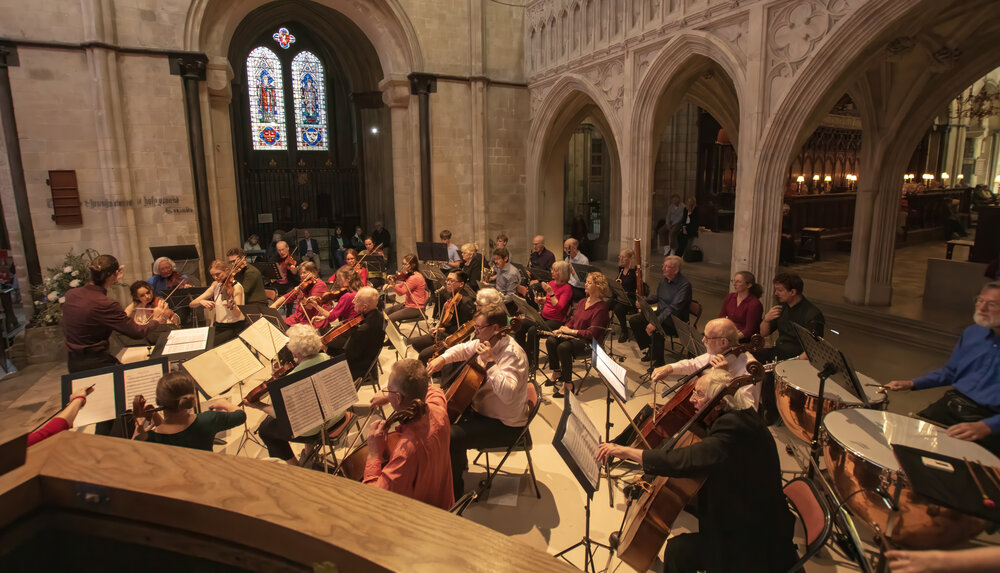
On Tuesday 28 October at 1.10pm, Charles Harrison will be playing Poulenc’s Organ Concerto at a Chichester Cathedral Lunchtime Concert, along with members of Chichester Symphony Orchestra. He talks about what the audience might be looking forward to.
I first played this piece when I was a student, as part of my final concert before leaving university 30 years ago. I also performed it a few years later as part of the Belfast International Festival with the Irish Chamber Orchestra in on the very large organ at St Anne’s Cathedral. That was about 25 years ago, and it is lovely to be tackling it again after so long.
It’s a fun piece. It seems to have its roots partly in Vaudeville, a theatre tradition from France from the middle of the 19th century, but which really took off in the United States in the early 20th century. Vaudeville was about pure comedy, without any sort of moral overtones ; there’s nothing “improving” about it – it was just for fun. The Concerto is terrifically entertaining and varied: with a loud, dissonant chord, Poulenc pulls the audience from the slapstick of one section to the emotional pathos of the next.
He wrote this piece for organ, strings and timpani, the organ provides all the colour that would otherwise come from the orchestral winds. The organist Maurice Duruflé advised Poulenc on the registration instructions (choice of stops) requiring a vivid palette of colours. The timps add rhythmic punch, sometimes reinforcing the organ’s deep pedal notes.
The concerto is varied, dramatic, melodramatic, entertaining, almost silly at times: the contrasting sections are linked into a single movement lasting about 20 minutes.
Technically, the piece is not highly demanding, although there are some fast and fiddly passages. Manging the ensemble between the organ and orchestra will be a challenge, since I will be some distance from the other players. It is necessary to play slightly ahead of the beat, in order to allow for the sound of the organ to reach the orchestra on time. Sound travels at about 700mph, which is slow enough cause ensemble challenges even over distances of 25 or 20 meters.
Chichester’s organ is in a transept to the side of the main body of the building; the sound therefore speaks across the building, rather than directly down the centre of the nave. So it’s a bit diffuse, a little bit distant, and that might require slightly sort of stronger style of playing, and a clearer articulation in order to achieve the necessary clarity.
This work is important, and takes its place among a small number of organ concerti. Other works in the genre include several by Handel, and pieces by Rheinberger and Marcel Dupré. Samuel Barber’s Toccata Festiva is an organ concerto in all but name.
In the performance, the conductor and I agree that we should not take undue liberties. Where Poulenc offers sentimentality, it is all written into the music, and requires little additional emotional input from the performers. It is well known that Poulenc disliked overegged expressive gestures in performance.
Charles is Organist and Master of the Choristers of Chichester Cathedral.

Article: Horace Hawkins and the Poulenc Organ Concerto by Alan Thurlow, Organist Emeritus, Chichester Cathedral
In 1938, when Horace Hawkins became Organist of Chichester Cathedral, his appointment was widely regarded as a ‘stop-gap’ measure after a difficult search by the Dean and Chapter to identify a worthy successor to the well-known Dr Harvey Grace, Organist since 1931 and nationally known through his work as Editor of the magazine The Musical Times.
By then ‘Hawkey’ (as Horace soon became affectionately nicknamed by his young choristers) was 58 years old and already approaching retirement from his post as Music Master of Hurstpierpoint College, a position he had held since 1916. Who, at that time, could have imagined that due to the outbreak of war in 1939 and the years of recovery that followed, it would not be until 1958 that Hawkey (by now approaching the age of eighty) would finally retire?
He was succeeded at the Cathedral by the youthful and energetic John Birch, previously Organist of All Saints, Margaret Street, in London (a church that then had its own Choir School which, as in Cathedrals, enabled the Office of Evensong to be sung on a daily basis).
Hawkins had had an interesting and unusual career. Born in 1880 in Tunbridge Wells, he became a chorister at the church of King Charles the Martyr. Later he was articled to W.H.Sangster at St Saviour’s, Eastbourne – one of a number of major parish churches along the south coast which at that time boasted its own Choir School – and while there he took piano lessons from Miss Hamilton Stirling (a pupil of Clara Schumann). Later he became Assistant Organist at Winchester Cathedral, serving under William Prendergast, before moving back to Sussex to become Organist at St Andrew’s, Worthing, where in 1903 the notable firm of Hunter & Sons had built a fine new three-manual organ, still in use there today.
The details of Hawkins’ life in the ensuing years are not well documented, but it seems possible that in 1909 he may have encountered the internationally renowned Charles Marie Widor, who came to England in that year to conduct a concert in the Queen’s Hall, at which one of the works featured was his own Symphonie No.3 for Organ and Orchestra. Perhaps it was this that fired Hawkey’s enthusiasm for the French organ tradition? Roll on a few years, and the next time he surfaces is in 1911, by when he had become a student at the Sorbonne as well as Organist of the English Church of St George in Paris. Whether he moved there first and discovered the vacancy at St George’s once he was there, or whether he saw an advertisement over here and applied for the position while still in Worthing, we don’t know. What we do know is that in 1913 Hawkey began having organ lessons from Widor, and soon became a favourite pupil of the maestro.
By 1915, no doubt on account of the outbreak of the First World War, Hawkey – now a graduate of the Sorbonne with the degree of B ès L – had returned to England where he soon took up his appointment at Hurstpierpoint College. This was not, however, the end of his connections with Paris and Widor. Once the war had finished Horace resumed his visits to take organ lessons with Widor and, according to Andrew Thomson in his excellent book The life and times of Charles-Marie Widor (OUP), became ‘a visitor for whom Mme Widor had a particular liking’. Widor composed a setting of Ave verum for the choir of Hustpierpoint (the copies are printed though it seems it was never published) on which he gave the dedication à Monsieur Hawkins (presumably pronounced without the ‘H’!). Later, Widor invited the Hurstpierpoint choir across to Paris to take part in a concert at the Musée de Caen, and his Ave verum was one of the works performed on that occasion. It was no doubt through his friendship with Widor that Hawkins became established as a well-known figure among the notable circle of Paris organists and musicians of that period, names such as Dupré, Duruflé, Vierne, and the younger Francis Poulenc. Hawkins was clearly very well connected: when he and his wife had a daughter, Anne, her godparents were Widor together with Siegfried and Winifred Wagner.
It was in 1938 that Poulenc composed his Concerto for organ, timpani and strings. Following a private performance in the December of that year, the first public performance was given in June 1939. It would be nice to think that perhaps Horace Hawkins made the journey over to Paris to be present on that occasion as he clearly became aware of the existence of this new and important work. How he obtained a copy of the score and parts we do not know, but he obviously did (presumably before the fall of Paris in June 1940) as in 1943, here in Chichester Cathedral and in the middle of the Second World War, he promoted the first UK performance of Poulenc’s Concerto for organ. The orchestra, conducted by Horace, was the Chichester Orchestral Society, predecessor of today’s Chichester Symphony Orchestra, and the organ soloist was the young and talented Anne Sheail, then Assistant Organist at the Cathedral. The distinguished music critic Felix Aprahamian travelled to Chichester to be present and Anne, in her later years, always enjoyed recounting how, at the end of the performance and when the applause had died down, Felix had been so impressed by the work that he stood up and asked if they would be prepared to play it again, which they duly did!
During his years as Organist at Chichester Hawkins brought with him many aspects of the repertoire and Catholic traditions he had experienced in the major churches and cathedrals in Paris, not least in his inspiring extemporised organ voluntaries and interludes during the liturgy. Widor had also composed a fine setting of the Mass for two choirs and two organs, the second choir being composed of tenors and basses from the Seminary in Paris. In Chichester, with the Theological College just down the road in Westgate, the circumstances were ideal to be able to include Widor’s Mass in our own choir’s repertoire, and generations of Chichester ‘theologs’ vividly recall coming to the Cathedral on Sundays to join the cathedral choir in performing this work. As well as championing the music of Widor, Hawkins also introduced the choir to works by other French composers, notably Henri Potiron (1882-1972) who was the Choirmaster at the Sacré-Coeur church in Paris for nearly 40 years.
Having had no prior connection with Chichester I was unaware of any of this when I arrived here in 1980, but was soon to encounter the memories and reminiscences of Old Choristers when they returned here for reunions. Anne Sheail, who during her years as Assistant Organist had married Morris Maddocks (later to become Bishop Morris), a ‘theolog’ who during his time as a student at the College had fallen in love with the attractive and talented young lady who played the organ at the Cathedral. Around the turn of the present century Bishop Morris and Anne moved back here in retirement, and she was a constant source of delightful reminiscences about Hawkins and his ways. The Widor Ave verum was not in the choir’s repertoire when I arrived, and I was unaware of its existence until coming across it while compiling a new catalogue of all the music in the Choir Library. I was delighted to be able to bring it back into the repertoire, and to include it in concerts we gave and services we sang at on a number of tours that our choir made in France.