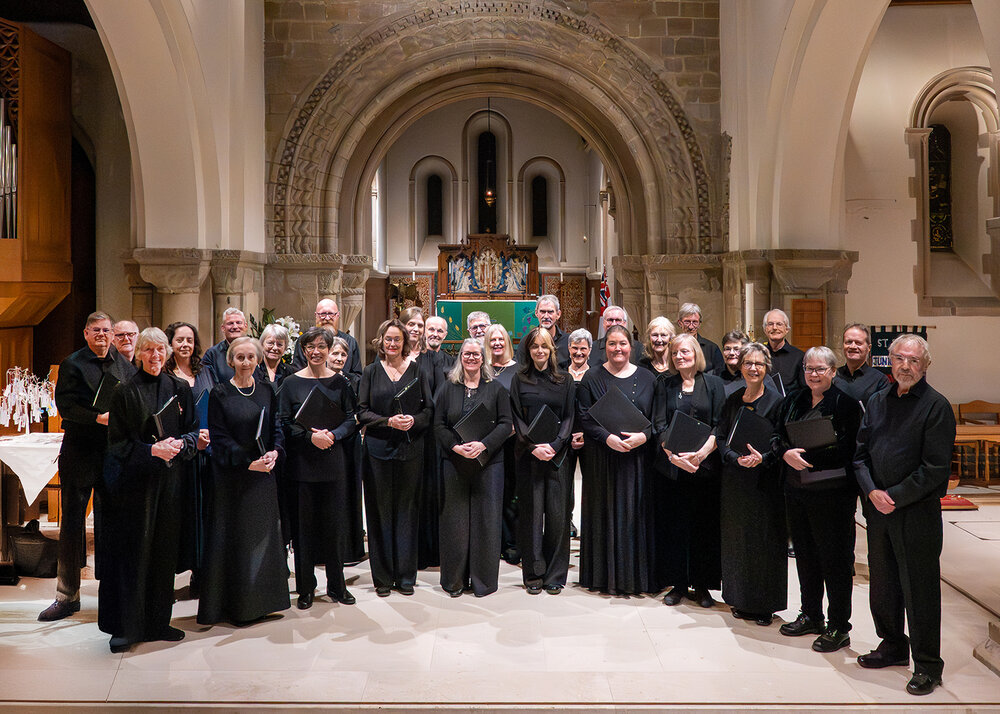
The Renaissance Choir’s concert at St Peter’s Petersfield in October 2025 gave us not just one programme but, in effect, three interlinked ones.
Central to their intentions was their celebration of the 500th anniversary of the birth of the renowned Italian composer, Giovanni Perluigi da Palestrina. They chose one of his more challenging works, a setting of the Mass for double choir developed from musical ideas created for his motet based on the text ‘Fratres ego enim accepi’. Two of the composer’s sacred motets complemented the Mass’s six movements, of which ‘My beloved is to me a sachet of myrrh’ (in the translation) made the connection with the evening’s second theme.
This was to present a range of more contemporary musical settings of texts mostly from the Biblical ‘Song of Songs’. It was fascinating to hear how music from one side of such a chronological gulf could reach out a stylistic hand toward the other. Palestrina’s suspensions (notes added stylistically to the usual triad) were complemented by the added-note style which formed the basis of Eric Whitacre’s A Boy and a Girl from 2004, and there were plenty of plangent suspensions too in Stephen Paulus’s Arise my love (also from 2004) and Eleanor Daley’s Upon your heart (from 1999), all clearly enjoyed by the singers.
As it turned out, Palestrina’s music was a stylistic pivot around which all else turned, because the concert opened with music from four centuries even earlier, by the 12th-century abbess Hildegard of Bingen. Its extended vocal solo was evocatively supported by the Choir’s vocal drones sustained in various registers.
The concert’s third strand complemented the contemporary vocal items with relatively contemporary instrumental ones. At the centre of the concert’s first half, Karen Kingsley delicately played Maurice Ravel’s early and familiar piano solo Pavane pour une Infante defunte, and I was struck by Ravel’s own use of added-note ‘ninth chords’. In the second half, her nimble-fingered playing of Peter Copley’s short Scherzino brought its quirky and colourful character vividly to life.
The Choir demonstrated commitment to this wide range of music and musical styles, mostly with success, though there were moments when the complexities of Palestrina’s 8-part counterpoint came momentarily adrift. The rich vocal textures of the Mass rang round the church, and the music’s use of phrases which resound back and forth between the two ‘quartets’ of singers was exploited with some success. The Choir’s sound has colour and warmth; if individual voices occasionally stood out unsuitably from the blend, the various solos were taken with assurance.
The highlights of the concert for me came right at the end, when the Choir sang two items with which they were clearly very familiar and could fully express their confidence and enjoyment: Daley’s Upon your heart which demonstrated warmly blended colours, and Palestrina’s lively Exsultate Deo which was emphatically rhythmic.
Peter Gambie expressed the hope that music of the Renaissance – the Choir’s principal purpose – would not be allowed to fall out of fashion or favour. I doubt that this is likely as in the end it has a timeless quality, something which composers of our time – such as Daley, Paulus and Whitacre – are clearly drawn to in their own way. And the fulsome audience which came to enjoy this experienced Choir’s singing would surely endorse this too.
Christopher Mabley
Image (c) Ian Crowson, Petersfield Photographic Society