Greg Slay on the contribution of the Chichester Symphony Orchestra (CSO) to the city’s classical music scene (update January 2026)
Chichester’s Symphony Orchestra can justifiably claim to be the oldest secular musical ensemble in the city still in existence.
A “Chichester Instrumental Society” is known to have existed in 1881 and is listed in the Chichester Directory Handbook and Almanac for that year. The Society’s name made its first formal appearance in print in the Bognor Observer and West Sussex Recorder newspaper of 25 December 1889 in which it was announced that the Society was ‘prepared to receive engagements for banquets, balls, evening parties’. This is the date the orchestra now documents for its foundation. A review in the same newspaper of a concert on 14 April 1896 reported that ‘the various items on the programme were admirably rendered and reflected the greatest credit on every member of the orchestra.’ It was not until the following year – 1897 – that Chichester City Band, our local brass band, was founded (and it too continues to exist to the current day).
The Chichester Instrumental Society was renamed as the “Chichester Orchestral Society” in 1906 and on 10 May performed its ‘First Grand Concert’. Works by Mendelssohn, Grieg, Schubert, Auber and Smetana were performed, conducted by Frederick Crowe – the Organist and Master of the Choristers at Chichester Cathedral. The soloist at later concerts in 1907, 1908 and 1912 was the Countess of March (Hilda Gordon-Lennox), a talented amateur pianist and grand-daughter of Victorian railway pioneer Thomas Brassey; she later became the Orchestral Society’s Chairman. Unfortunately, no photographic records of her as concert soloist – or playing the piano at home – are held either by the current CSO or by the Goodwood Estate.
During the 1920s the orchestra gave concerts at Chichester’s Picturedrome on South Street (occupied today by the Iceland supermarket). Composer Norman Demuth took over as conductor between 1929-1935. His orchestral piece Selsey Rhapsody was inspired ‘by a view of Selsey Bill in the sunlight on a bright autumn morning’. The orchestra lost many members during World War 2 when they signed up for military service. Members had however already formed a slimmed-down Chichester Light Orchestra and this became the mainstay for concerts entertaining wartime audiences. The Light Orchestra continued with performances through to 1966 with local music teacher Olive Lewis conducting both orchestras.
Anniversaries and special events, 1930s-1990s
The Chichester Orchestral Society’s 35th anniversary concert was on 31 May 1934 at the Assembly Room in North Street. The programme included Mozart’s Maurerische Trauermusik and the world premiere of Norman Demuth’s Merciles Beaute, set to words by Chaucer.
In May 1943 the UK premiere of Poulenc’s Concerto in G minor for Organ, Timpani and Strings was given in Chichester Cathedral. Members of the Chichester Orchestral Society formed the orchestral accompaniment to the young and talented Anne Sheail, then Assistant Organist at the Cathedral, on the cathedral organ. [This concerto was recently the centrepiece of the Symphony Orchestra’s October 2025 lunchtime concert in Chichester Cathedral with Charles Harrison, Organist at the Cathedral, as the soloist.]
Several concerts were given in the Recreation Hall at Graylingwell Hospital over the years including one to celebrate the coronation of Queen Elizabeth II on 8 June 1953: the programme included Montague Phillips’ The Fishermen of England, Edward German’s Who were the Yeomen of England and William Purcell’s Fairest Isle, all isles excelling. [Graylingwell Hospital closed in 2001.] The orchestra’s 200th concert was held on 18 January 1972 at Chichester High School for Boys, and included music by Rossini, Haydn, Gounod and Schubert. In December 1972 a joint performance with Chichester Amateur Operatic Society was held in memory of Olive Lewis who had died earlier in the year.
In November 1981 the orchestra combined forces with music department staff and students at Bishop Otter College (now the University of Chichester) and became known as the Chichester Symphony Orchestra. More ambitious programming resulted and both rehearsals and concerts took place at the College. In late 1986 the orchestra moved again, this time to County Hall in Chichester, for weekly rehearsals. The orchestra’s centenary events began with a Victorian-themed party held at County Hall on 26 June 1990. The following year on 13 April a centenary concert was given at Christ Church on Old Market Avenue, Chichester. The soloists at that centenary concert were Alan Thurlow, the Cathedral’s then Organist and Master of the Choristers, Jeremy Smith, an oboist and sixth-former from Bishop Luffa School, and Patrick Moore, astronomer, broadcaster – and xylophonist!
CSO as we now know it today
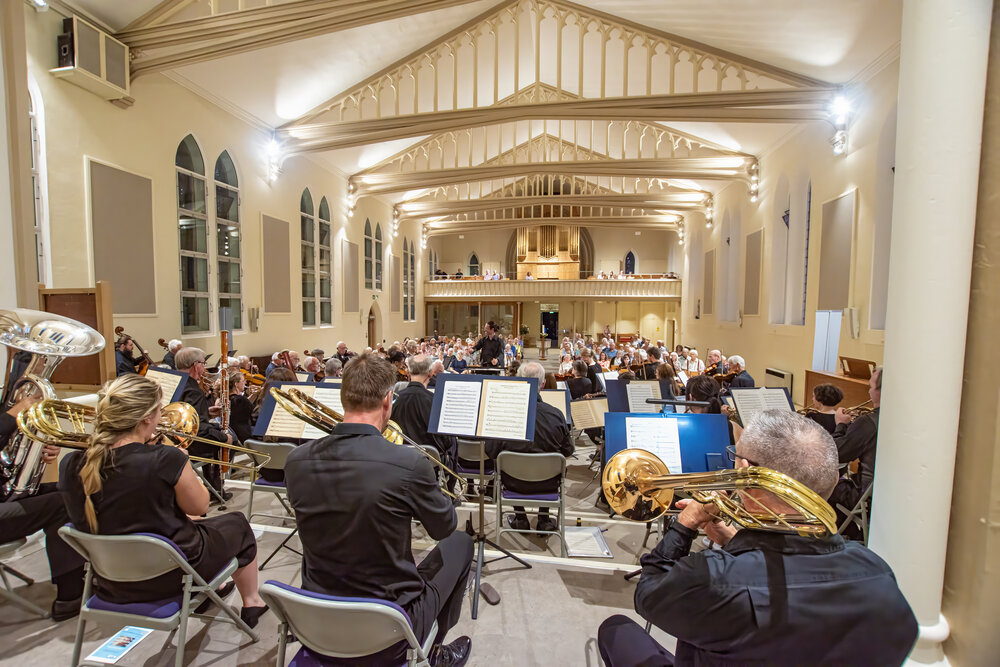
Orchestra members, all adults and living within a 20-mile radius of the city, pay an annual membership fee, with a reduced rate applicable for those under 26 years old. The orchestra has a core membership which continues from year to year but new players are always welcome to fill gaps as they emerge or to deputise for existing players in concerts where necessary. The orchestra does not require admission by audition but players must be at Grade 6 or above or have equivalent orchestral experience. The orchestra often performs music at a level of complexity not dissimilar to Grade 8. A music sub-committee, to which both the leader and conductor contribute professional expertise, researches and recommends the future concert programme content.
Simon Wilkins has conducted the orchestra since 2018. Simon lives in Southampton and works professionally as a music teacher, conductor, and composer. He is also an accomplished cellist and has performed as a soloist with CSO as well as with various orchestras in a number of internationally prestigious venues across the UK and Europe.
Natalia Corolscaia was appointed as the orchestra’s leader in 2022, taking over the role from Catherine Lawlor. In summer 2025 Natalia and her family returned to live in Moldova where she had been born and brought up.
Alex Hu then joined the orchestra as leader in September 2025. Alex enjoys a diverse career in the UK as a freelance violinist, violist, and teacher. He was born and brought up in New York and began learning the violin at the age of six. He earned his BMus in Violin Performance at the Aaron Copland School of Music. He then came to the UK to complete a Master’s degree at the Royal Welsh College of Music and Drama – studying with Lucy Gould and Marcia Crayford. Alex’s performances as a freelance chamber musician, soloist, and orchestral musician have taken him throughout the UK, USA, and Asia.
The orchestra is run as a charity with limited finances. Its trustees are drawn from within the membership. CSO does not employ any staff although it does pay fees to the conductor and the leader. Our income is topped up by the sale of concert tickets, a grant from Chichester City Council, the support of the Friends – a Friends scheme was launched in 2024, with business sponsors added in April 2025 – and by private donations, trusts, and legacy gifts. Expenditure mainly relates to our rehearsal and concert costs such as venue hire and paying freelance players to supplement the orchestral forces required for some pieces.
The orchestra gives four concert performances each year. The first in the year is a family concert. Music from recent blockbuster films is always popular for these and recent concerts have for example featured a number of film themes composed by John Williams. The second concert of the year is held in the spring either at the end of March or in early April. For example, the spring concert 2025 showcased the combined talents of CSO and the University of Chichester Conservatoire in a concert featuring the combined forces accompanied by astrophotography projections and a narrator. The theme was ‘Space’ and the concert included music by Richard Strauss, Gustav Holst, Claude Debussy, David Bowie, John Williams, Elton John and The Byrds.
The summer concert is always a highlight of the Festival of Chichester and usually follows the traditional approach of overture and concerto in the first half, and a symphony or symphonic variations piece in the second half, perhaps accompanied by one or more shorter pieces. Our final concert in the calendar year is held at October half-term in the Chichester Cathedral lunchtime concerts series. Forthcoming concert programmes are publicised on the orchestra’s website (chichesterso.co.uk). Tickets are available online through TicketSource, in person from orchestra members, or on the door if there are any left. The Cathedral concert is free entry, but it is best to get there in plenty of time as it is always a full house.
CSO and the future
Sustaining the existing audience base, building new audiences and welcoming in new players are all essential to the orchestra’s continued success in Chichester’s cultural life. Expanding the repertoire to feature more Sussex-based composers or composers who have composed pieces with a Sussex area connection is one way to do this. Another is to ensure that women composers feature more prominently. For example, the concert programme in July 2024 featured the works of Ethel Smyth, Alice Mary Smith, and Ruth Gipps. We will do this alongside continuing to feature the essential classics we and our paying audiences all know and love.
The orchestra aspires to be the best it can be for players and audiences alike. Recent reviews of our concerts on the Music in Portsmouth website provide evidence of the quality of the musicianship of the orchestra today – and auger well for the future.
All our concerts are performed live and are not recorded.
Concert programme 2026
Note: the what3words address for St Paul’s Church is: fresh.shave.bridge.
Concert: Movie Night. St Paul’s Church, Chichester PO19 6FT, 4pm, Sunday 25th January 2026 (note earlier start time)
Programme to include music from musicals, films, radio and television shows to appeal to people of all ages. Composers represented include John Barry, Elmer Bernstein, Eric Coates, James Horner, Aram Khachaturian, Henry Mancini, Sergei Prokofiev, Richard Rodgers, John Philip Sousa, Giuseppi Verdi, William Walton, Charles Williams and John Williams.
The Barry Goodchild Memorial Concert. St Paul’s Church, Chichester PO19 6FT, 7.30pm, Saturday evening 21st March 2026.
Programme: Verdi’s Nabucco overture; Max Bruch’s Kol Nidrei with soloist Simon Wilkins; Tchaikovsky’s Symphony No 5 in E Minor; and Samuel Coleridge-Taylor’s Ballade opus 33.
The Mary Hartley Memorial Concert (Festival of Chichester). St Paul’s Church, Chichester PO19 6FT, 7.30pm, Saturday evening 11th July 2026
Programme: Simon Wilkins’ Tierra del Fuego (revised); Elgar’s Cello Concerto in E Minor with soloist Aglaia Carvalho-Dubost*; Robert Schumann’s Symphony No 1 in B Flat Major.
*Aglaia Carvalho-Dubost, has been studying at the Royal College of Music Junior Department since the age of 13 and is currently studying cello with Robin Thompson-Clarke. She has also studied piano with Daniel Hill and jazz piano with Sara Dhillon. Aglaia has performed several concertos as soloist as well as receiving scholarships for ProCorda chamber music courses in Suffolk, and masterclass courses in Scotland. As a member of the National Youth Orchestra, she has given concerts at the Barbican, the Royal Festival Hall and the Royal Albert Hall. Her string quartet has recently performed at the Wigmore Hall.
Lunchtime Concert: Chichester Cathedral, PO19 1PX, 1.10pm, Tuesday 27 October 2026
Programme to include Saint Saens’ Piano Concerto No 5 in F Major (‘The Egyptian’), with soloist Tim Rumsey.
QR code for access to the CSO website:

Greg Slay FRSA has been Chairman of Chichester Symphony Orchestra since 2022. He has lived in the city since 1991.
An earlier version of this article appeared in the Newsletter of the Chichester Society, in June 2023.
Picture credit: Jim Wakefield