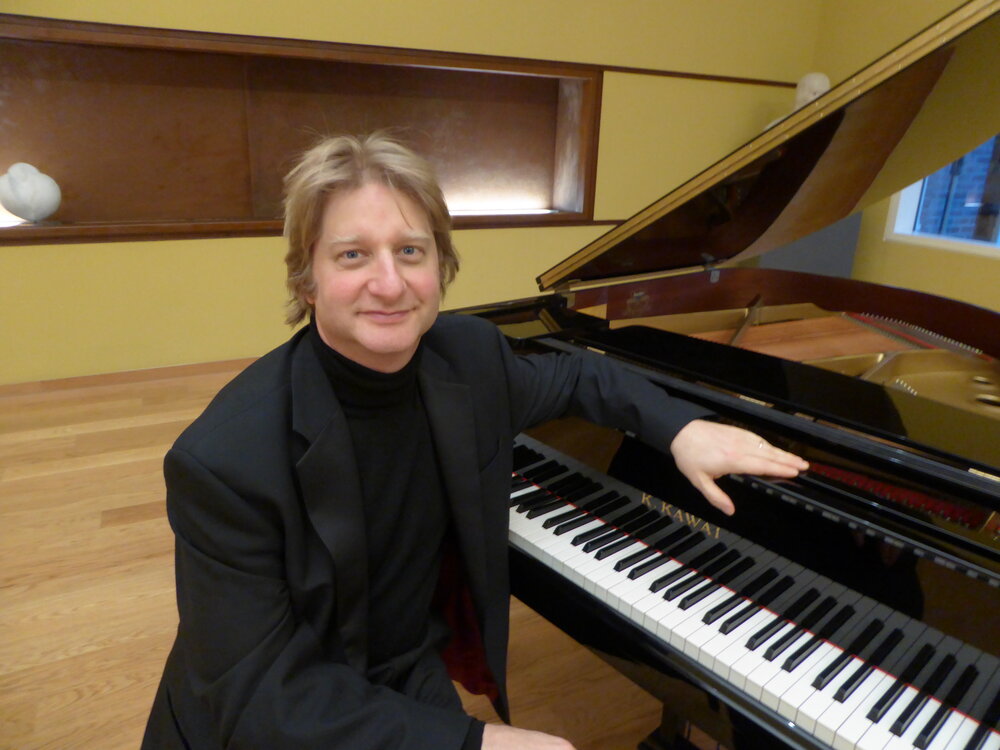
At 3pm on Saturday 31 January, Mikhail Lezdkan, cello, & Béla Hartmann, piano will be celebrating Schubert’s Birthday in a concert at St Peter’s, Petersfield.
Béla tells us more about the concert and himself.
What are you looking most forward to when performing at this concert?
There will be another opportunity to explore beautiful music with my friend Mikhail, with whom no recital is the same and no piece of music routine.
Who and/or what have been the most important influences on your musical career or interest in music?
My teachers all had decisive influences on me in different ways, and I wouldn’t be here today without each of them. Other than my teachers the biggest musical influences come from the conductor Wilhelm Furtwängler who to my mind found the ideal balance between the musical moment and the whole, or – if you like – between admiring the view and getting on with the walk.
Pianistically my two main poles are Edwin Fischer and Dinu Lipatti, both very different but both utterly genuine and humane.
As regards musicians playing currently, I admire both the conductor Teodor Currentzis and the violinist Patricia Kopatchinskaja, both of whom are so full of imagination and energy that they keep everything alive.
What are the particular pleasures and challenges of collaborating with other musicians?
The challenges are finding partners with whom one can harmonise and with whom one can easily discuss options and reach a modus vivendi. That has taken me several decades. But when it works it is wonderful, as there is so much one can learn from others, and the coming together of two different musical personalities is magical.
Are there any composers for whom you feel a particular affinity?
Schubert has always had a special place in my heart. His music combines beauty, depth, complexity and mystery with a very human character. In contrast to the divine perfection of Bach, Beethoven and Mozart, Schubert comes across as a very fallible human being, with all the insecurities and weaknesses we all share, and simply with a unique window into the world beyond.
Which works do you think you are able to perform best?
I enjoy long multi-movement works, as they allow me to immerse myself in their world, creating their own sense of time and development.
What are your most memorable experiences, either as a performer, composer or listener?
As a performer there have been many happy moments – not least with Mikhail Lezdkan. Some years ago we played in a Schubert Day, with lots of different works, including a cello and piano trio. It was a lovely experience.
Sometimes in a concert you feel that things just fall into place, and you discover a completely new view of the music. That can happen anytime or anywhere, and of course no one in the audience notices, as they just take things as they come. But it makes all the effort worthwhile.
What advice would you give to those who are considering a career in music?
Go for it! There is no more rewarding life than living with the music you love.
How would you define success as a musician?
Still being there after 30 years of playing. And perhaps feeling there are some things you can do slightly better than at the beginning.
What would you like to be doing in 5 years’ time?
Discovering music or ways of playing that I’m not aware of now.
About Béla
Find our more about Béla at http://www.belahartmann.com
Since becoming a semi-finalist at the Leeds International Piano Competition in 2000, Béla Hartmann has enjoyed a wide ranging career, performing in venues from New York (Carnegie Hall) and London (Wigmore Hall) to smaller venues across the UK and Europe.
His London series of the complete Piano Sonatas of Schubert at Steinway Hall culminated in the release of his highly praised debut CD of Schubert Piano Works (Meridian), and his performances for the Beethoven Piano Society of Europe at St James’s Piccadilly featured Beethoven’s piano variations, including the monumental Diabelli Variations.
Aside from that his repertoire includes contemporary works by composers such as Birtwistle, Boulez and Bussotti, and he gave UK premieres of works by Widmann and Petr Eben. His most recent CD features the early Piano Concerto in A Minor by Mendelssohn, recorded with the Keld Ensemble. Béla Hartmann is also a keen musical essayist and has published articles and reviews on a wide range of music-related topics.
Béla studied with Vadim Suchanov and Nicolas Economou in Munich, John Bingham at Trinity College of Music, London, and with Elisso Virssaladse in Munich.
As a teacher Béla has worked with pupils of all ages and levels from beginners to post graduate music college students. His pupils have enjoyed successes at concerts, competitions and auditions, have performed piano concertos, gained diploma qualifications and gone on to pursue professional careers. He has adjudicated in competitions and given masterclasses as well as lecture recitals.
Béla only recently began composing but has in that time written a variety of small and large pieces for aspiring pianists. He is particularly interested in chamber music collaborations between early and intermediate pupils. His own concert pieces often take their inspiration from vocal works by Brahms and other late romantic composers, and the poetry of Rilke.