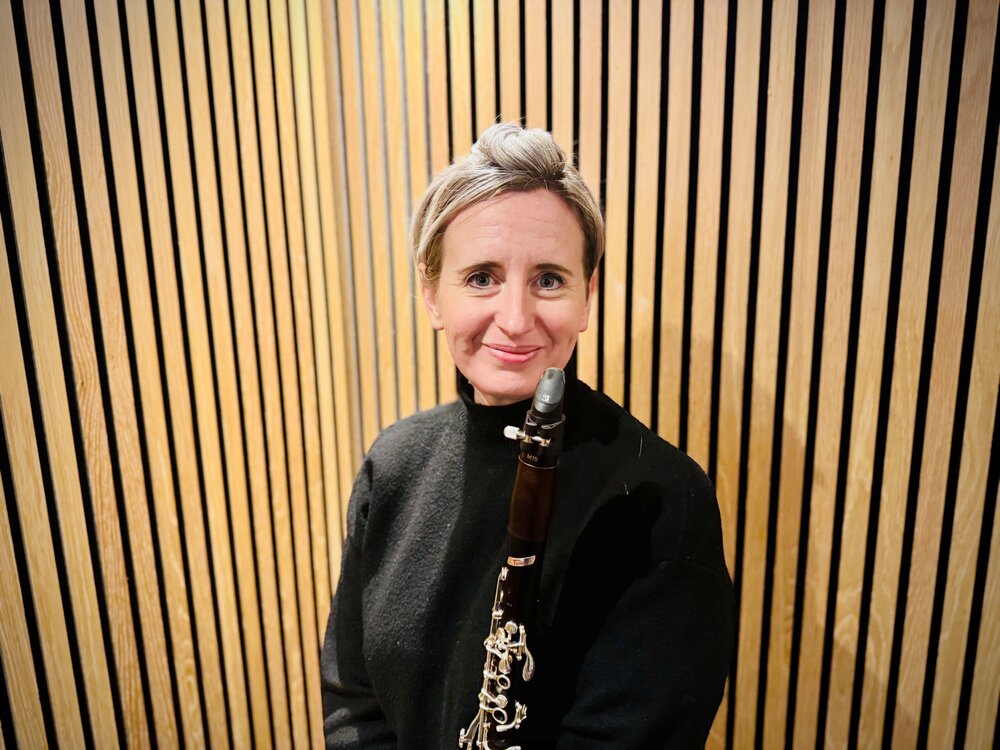
Jen is playing at four concerts in the Petersfield Musical Festival this year: St Cat’s Ensemble, Froxfield Choir/the Brass Breakout Jazz Orchestra, World Postcards and with the Petersfield Orchestra.
What are you looking forward to in this year’s festival?
I’ve performed at the festival for around the last 12 years, and performing in 4 concerts in one week is very exciting!
On Friday 13th March,I am playing with St Cats Wind Ensemble. We are performing Rhapsody in Blue with Keelan Carew, a very talented pianist. In the second half, we’re performing The Lord of the Rings Symphony by Johan de Meij. It’s a really interesting work depicting the books. You can really hear the stories coming to life in the music. Smeagol is particularly menacing! St Cats is an outstanding wind orchestra. They were awarded a prestigious platinum level at The National Concert Band Festival in 2024, and we are hopefully going to perform in Prague next year as part of the International Wind Band Festival.
On Saturday 14th March, I am performing with the Brass Breakout Jazz Orchestra. Moving from playing tenor sax the night before for a wind band concert to then playing jazz sax in Duke Ellington’sSacred Concert, which is for big band, is different. Complete with choir, gospel singer and a tap-dancer, this is such a rare piece to see performed. It’s a sacred jazz mass, and a fine and exhilarating work that you should really go and see!
On Tuesday 17th March, I am performing in the World Postcards lunchtime concert. For this concert, I am playing clarinet and bass clarinet. George Venner’s original compositions are based on themes from around the world. They’re in a variety of different styles and George has composed them in a style very pertinent to the musical feel of each country. There is something for everyone to enjoy! The concert also features Angela Zanders and Karen Kingsley on piano, and Rob Blanken on clarinet, and they will also be performing other chamber works throughout the afternoon.
On Thursday 19th March, my last appearance at the festival this year is with Petersfield Orchestra. Alongside Rob Blanken, I am one of the regular clarinet players in the orchestra. However, because of the works chosen on this occasion, we need extra players and I am therefore playing bass clarinet and alto sax. It’s a wonderfully lively programme this time with a large orchestra. The Overture to Candide is a hugely exciting work, and instruments you wouldn’t normally hear have little solos passing through the texture. Karen Kingsley is then performing Gershwin’s Piano Concerto which has a big jazz influence within it and explores different harmonies you wouldn’t normally expect for an orchestra. Finishing off with Rachmaninov’s Symphonic Dances and his magical saxophone line in the opening movement is yet again a different timbre from the Petersfield Festival Orchestra concerts you may have heard before!
I feel privileged and lucky to be asked by these various groups to play for them, and I am looking forward to these concerts immensely. I think the main challenge for me will be moving between those styles between concerts: it’s very different improvising in a jazz concert to then playing a bass clarinet part in an orchestral concert the following week!
What have been the most important influences on your musical career so far?
I started playing a recorder as most people do at the age of 6 in my headmistress’s office at school. I remember 20 of us going in and from that moment, I just thought, I love this! I started playing clarinet at seven. Mum and Dad took me to a music shop, and I was given a clarinet. I really wanted to play the trombone, but I was too frightened to say to them, “I want to play the one that goes like this.” And if only I had said that, I do wonder what might have been!
I played with Hampshire Recorder Sinfonia and Emsworth Concert Band as a child. I also played in the National Youth Music Theatre and National Children’s Wind Orchestra. I went to South Downs College and studied double music A-level before being accepted at Birmingham Conservatoire studying recorder, and latterly University College in Chichester. I went on and gained my PGCE in teaching, along with an LRSM in recorder performance.
I started to play saxophone suddenly when I was 15. There was a production of Chicago at school, and the head of music asked me if I played the sax. My answer was no. At that point, he handed me a soprano and alto sax, and told me I had two weeks to learn before the show! And that was my baptism into learning how to play saxophone. I’ve never had a saxophone lesson in my life, and oddly, I seem to play saxophone professionally more than anything else now, which I absolutely love and I adore, and that was a hugely influencing moment for me!
I never planned to go into teaching, and yet, I have had a thriving teaching practice for 20+ years! I’ve been really lucky to perform regularly locally too. I think I’m an all-round performer because I am asked to play in jazz gigs as well as classical and baroque concerts too. I think actually my early days, particularly learning how to play the recorder, really sets you up for being able to switch and learn other wind instruments. I still perform in a number of pit shows at the King’s Theatre and other places. I’m playing for Oklahoma and Chitty Chitty Bang Bang there soon.
I’ve been so lucky to have had so many musical influences growing up, including my teachers, groups I was playing in and also trips and tours, I have never ever wanted to do anything with my life apart from music. When I’m not performing, my full-time job is National Business Development Manager at Trinity College London.
And so what does that job at Trinity College London entail?
I introduce people to Trinity’s suite of music qualifications. I deliver INSET and training to music teachers across the UK teaching them about our exams and assessments. I get to travel quite a bit to conferences and events, and I get to work with musicians and teachers. I love what I do as I get to tell people about the wonderfully flexible exam syllabuses that Trinity provides for learners.
Would you give any particular advice to anybody embarking on a career such as yours?
It’s wonderful, but it can be hard! You have to be prepared to work very hard at it. And you need to make your own luck in this game. If you’re sitting in your house or your bedroom waiting for a phone call, those phone calls won’t come! Being a musician involves a lot of networking, and it entails playing as much as you possibly can, wherever you possibly can. You’ve got to be accessible and reliable for people. If you let people down at the last minute, or don’t return a call, chances are you won’t get a second go, and that will also mean you probably won’t get recommended for other things. There will always be better (and worse) musicians than you around. I hope the reason that I get asked for gigs is because I’m easy to work with as well as adaptable and reliable. And don’t be awkward – you need to have a lot of patience as a musician, and be nice. If you are rude to a conductor or your peers, you are unlikely to get the work. Nobody wants to work with a grumpy or rude person!
If you are trying to get some teaching, don’t be frightened to go and advertise. Teachers often ask, “how do I get more students?” The only way to get more students is to go out and advertise yourself. It sounds obvious, but I think some people can be really scared to do that or know where to start. Social media, sending around your CV to schools etc is also a great place to start!
The main thing is, be approachable, be adaptable, work hard and don’t be put off when things don’t quite go to plan. You’re only as ever as good as your last gig. Putting all of those things together and having a good work ethic are key. Some days you may be working for 18 hours. Other days you might have nothing in the diary, and you must be prepared to take the rough with the smooth.
Is there any light in the tunnel in terms of putting more music, more time and more resources into music, particularly in secondary schools at the moment?
That’s such a difficult question to answer! A lot of it falls into the remit of schools and their budgets and when they’re stretched as many are, it’s really tricky. There are lots of things that you can do with music that doesn’t cost anything: singing, for instance, can be a great thing. Music is such an important thing at a grassroots level because any person, can access music. You don’t need to be playing at the Carnegie Hall or even the mighty Petersfield Musical Festival. Everybody can be connected with music at some kind of level.
In every class within a school, you will have children there that don’t want to play music but should be encouraged to listen, you will have children that want to play an instrument, you will have children with educational needs, you will have children that need extra support because they are gifted and talented. But all of those children can make music at their own pace if supported appropriately. As a society we need to try and breathe more life into music.
Even listening to music can be underrated or underestimated. Introducing children to music is key to building positive foundations. For instance, if you have the children in the car, or the grandchildren over for the weekend, try putting on a piece of music in the background. A bit of Mozart, Classic FM, Roy Orbison, Taylor Swift – anything that you might have just to get those ears listening because those inspirational moments… Well, they can be there in the most banal of places, and I don’t think we are always aware of that. Music in our souls. That’s what we should try and aim towards as a society, I think, moving forward.
About Jen
Jen Flatman BA(Hons), LRSM, PGCE began her musical journey at the age of six on the recorder, before taking up the clarinet a year later. She went on to study recorder and viol with the Dolmetsch family, performing regularly as part of the Dolmetsch Ensemble. At 16, Jen added saxophone to her portfolio for a school production, later studying recorder and clarinet at South Downs College. She continued her recorder studies at Birmingham Conservatoire and the University College, Chichester (now the University of Chichester), graduating in Music in 2003.
Jen gained her PGCE in 2006, specialising in instrumental and ensemble teaching, and has since taught recorder, clarinet and saxophone across both state and independent schools. An active performer, she plays with a wide range of ensembles including Symphonix Orchestra UK, Symphonic Ibiza, South Coast Sinfonia, Brass Breakout Jazz Orchestra and Petersfield Orchestra. Jen is a founder member of Solent Baroque, a committee member of the European Recorder Teachers’ Association, and currently National Business Development Manager for Music at Trinity College London.