Who and/or what have been the most important influences on your musical career or interest in music?
As young children, my brother John and I joined a local church choir in Suffolk. We already had piano lessons, but singing the wonderful repertoire of hymns and choral music made a huge impact, so this was fundamental to my decision to have a career in music education and performance. John is about two years older than me, and when he started learning the organ I “got the bug” from hearing him play and wanted to start organ lessons too.
I knew fairly early on that I wanted to teach music at an advanced level, and this aspiration was fulfilled, initially with teaching at a school, then a college of further education, and finally for the 27 years before I retired as Director of Academic Studies at the Royal Marines School of Music in Portsmouth. In all these posts I managed to fit in a lot of recital work and choral conducting around the “day job”. Now that I have retired, I have more time to prepare for these activities.
I’ve been very fortunate to have experienced truly inspiring teachers. Without exception they were very open minded and patient as well as being fine players. If I’ve managed to bring just some of their patience, enthusiasm and knowledge to my own teaching I’ll have done well.
When teaching on the Sergeants’ and Bandmasters’ Courses at the Royal Marines School of Music, I was constantly amazed by the talents of the students. They showed extraordinary technical abilities as performers, conductors and composers and were always open to new ideas and new music. It was an exciting and stimulating environment, and I would definitely say that colleagues and students have been a constant inspiration, particularly at the Royal Marines School of Music.
What have been the greatest challenges of your musical career so far?
Of course there are the single event disasters, such as when a tenor horn diploma candidate and I as her accompanist got locked in the warm-up room. We saw the clock ticking relentlessly through the period allotted for her exam as we banged on doors and windows, yelling our hearts out in an attempt to get someone to let us out, but to no avail.
Another low point was at a large redundant church which was still used for occasional services: St Leonard’s Church, Bridgnorth. I was to play for a civic service and the choral music was fairly elaborate, so I arranged to get to the pre-service rehearsal early. The first three stop knobs I drew came out in my hand and the instrument, which had been described to me as “recently restored” was mostly unusable, the restoration still having some way to go. To cap it all, during the service after the first hymn I had to extemporise for over ten minutes on the three or four stops that just about worked in a rather dodgy and reluctant manner, while banners were presented at the altar. I still shudder at the thought of it all!
More generally, whenever playing the organ somewhere for the first time getting used to a strange instrument and acoustic in a short time is a challenge.
In choir training, knowing how far to stretch the choir in terms of repertoire choice and persistence in rehearsal when it’s not going well are definitely challenging skills.
On teaching, aural training is a challenge when students lack confidence. Students can be very sceptical when you try to assure them that with practice they’ll improve. I always put sight singing at the heart of my aural sessions, and less confident students almost invariably surprised themselves by what they had achieved by the end of their course.
What for you are the particular pleasures and challenges of collaborating with other musicians?
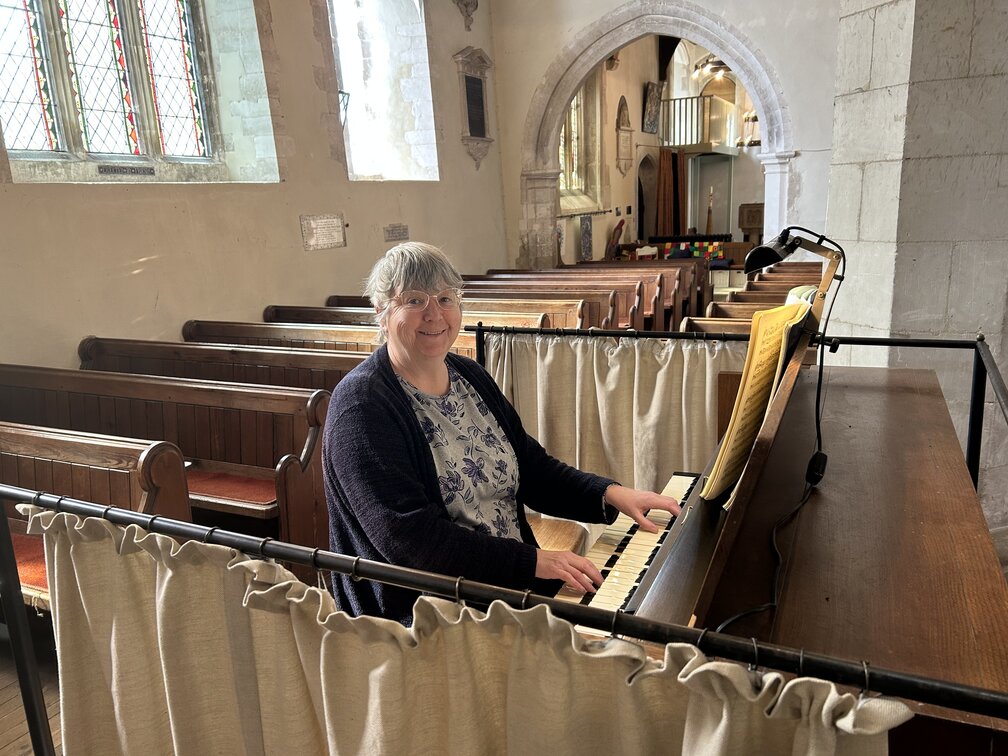
Like most directors of music at small churches, I’m responsible for the choir as well as playing the organ. I’m privileged to undertake these roles at a beautiful medieval church: the Parish Church of St Peter and St Paul, Hambledon. I love working with the choir, and it’s both a pleasure and a challenge to identify a range of suitable music. I try to achieve a good balance between introducing music new to the choir and singing music which they already know, and also to consolidate learning by repeating a work that has been recently sung for the first time. This all takes a lot of planning. It’s wonderful that people are prepared to give up their time to sing in church choirs and I love working with our singers.
I very much enjoy accompanying choral music and hymns, and get a chance to do this at our regular services at Hambledon Church. I’ll never tire of the magnificent hymns that are sung in churches. The combination of memorable words and fine music really speaks to people and sustains us at the most joyous and despairing points of our lives.
Former Royal Marines trumpeter Paul Hart is a fine player and I often accompany him for concerts and recitals. It’s lovely to work with someone for a long period (over twenty years in our case), and it means that there is a highly developed telepathy between us, even where the layout of the church means that the organ console is a long way from where he’s playing.
Are there any composers for whom you feel a particular affinity?
Of course, as an organist, JS Bach has a special place. The quantity and range of his organ music, together with its extraordinary technical accomplishment and artistry, are a constant source of wonder. Taken as a whole, his music for organ must be not merely the greatest output for organ by any composer, but the greatest output for any instrument by any composer.
I adore Mendelssohn’s organ music. Until fairly recently he was much criticised, as there was a view that his music “lacked depth”. It’s wonderful that more recently his music has been fully appreciated. There is a spiritual quality to the organ works that I find appealing.
Which works do you think you perform best?
Like most people, I’m never fully satisfied with a performance! However, I do have a special love of playing Mendelssohn and I think this has a positive effect.
In work with the choir, I greatly appreciate the English repertoire of the Victorian period. I’m very interested in nineteenth-century Britain and am a member of the Victorian Society. I also collect Victorian books on subjects such as education, social etiquette and medical matters. I do think that being so immersed in the period helps with the interpretation of music from that time. It annoys me that some people are quite dismissive of music by composers such as SS Wesley and particularly John Stainer, and yet they still perform it. The music of these composers can be highly effective, uplifting and moving, but as with any music, only if it’s taken seriously.
Which performances are you most proud of?
The trumpeter Paul Hart and I made two CD recordings – the first at Portsmouth Cathedral – and I’m proud of these largely because Paul plays like an angel!
What are your most memorable concert experiences, either as a performer, composer or listener?
As a member of the Suffolk Schools Jubilee Choir, I sang in the world première of the last work written by Benjamin Britten (Welcome Ode, written for Queen Elizabeth II’s Silver Jubilee). Despite the splendour of the occasion and Britten’s superb music, it’s probably better to keep quiet about this, as it shows my age!
During my time working with the Royal Marines Band Service I was given the wonderful opportunity to play the organ at the Royal Albert Hall for some years at the annual Mountbatten Festival of Music, featuring the Massed Bands of HM Royal Marines. Playing that magnificent instrument with the stupendously accomplished massed bands of the Royal Marines was an unforgettable experience.
As a listener, hearing Wagner’s Götterdämmerung conducted by Daniel Barenboim in a concert performance at the Royal Albert Hall was amazing – a monumental event. I find Mahler’s Second Symphony deeply moving and love hearing it live. The sumptuous colours, passion and unbridled exuberance of Messiaen’s Turangalîla Symphony make it an awe-inspiring work to hear live, so I take any chance to do this.
What advice would you give to those who are considering a career in music?
I think it’s important to have clear short-term and long-term goals and to be realistic. It’s also a good idea to get as much experience as possible, but equally to avoid taking on a schedule so onerous that there isn’t adequate time for preparation.
It’s vital to be organised and dependable, and this sometimes doesn’t come naturally for musicians, so it may need work.
I believe that listening to a wide range of performances – not focusing just on your own instrument or your favoured musical genres – is advantageous because all of these experiences are assimilated into your own musical personality and will have a beneficial effect on your playing.
Finally, enjoy it!
How would you define success as a musician?
I think the most important factors for a performer are: first, integrity in terms of respect for the composer’s intentions; second, a commitment to communicate effectively with the audience; and finally, appropriate, interesting and imaginative choice of repertoire.
What would you like to be doing in 5 years’ time?
I greatly enjoy conducting the choir at Hambledon Church and playing the organ there, so I hope to continue this work for as long as possible. I’m very conscious of the need to get young people involved in church music, and I’m currently discussing the possibility of starting a children’s choir.
I hope to continue to play in concerts and recitals, both as an organ soloist and as an accompanist.
About Liz
Elizabeth grew up in Suffolk. After gaining a Bachelor of Music honours degree at the University of Wales, Bangor, she spent three years as Assistant Organist at Bangor Cathedral. Next she passed the Post Graduate Certificate in Education (PGCE) course at Durham University, together with the Royal College of Organists’ Fellowship qualification (FRCO) and diploma in choral training and conducting (CHM). She later received an M Phil in musical analysis from the University of Wales, and then a Doctorate in Music Education from the Institute of Education, University of London.
After teaching and lecturing positions at schools and colleges, for twenty-seven years she was Director of Academic Studies, Higher Training at the Royal Marines School of Music. This involved teaching on the Bandmasters’ and Sergeants’ (M1) Courses, and leading the Royal Marines School of Music BMus (Hons) and MMus degree programmes.
As well as continuing to play for church services and recitals, she joined forces with the trumpeter Paul Hart for two trumpet and organ CDs: Celestial Trumpet and Golden Trumpet and continues to accompany him.
After seven years as Organist and Director of Music at St Ann’s Church, HM Naval Base, Portsmouth, in 2020 she was appointed to the same role at the Parish Church of St Peter and St Paul, Hambledon.