Petersfield Orchestra, 20 March 2025
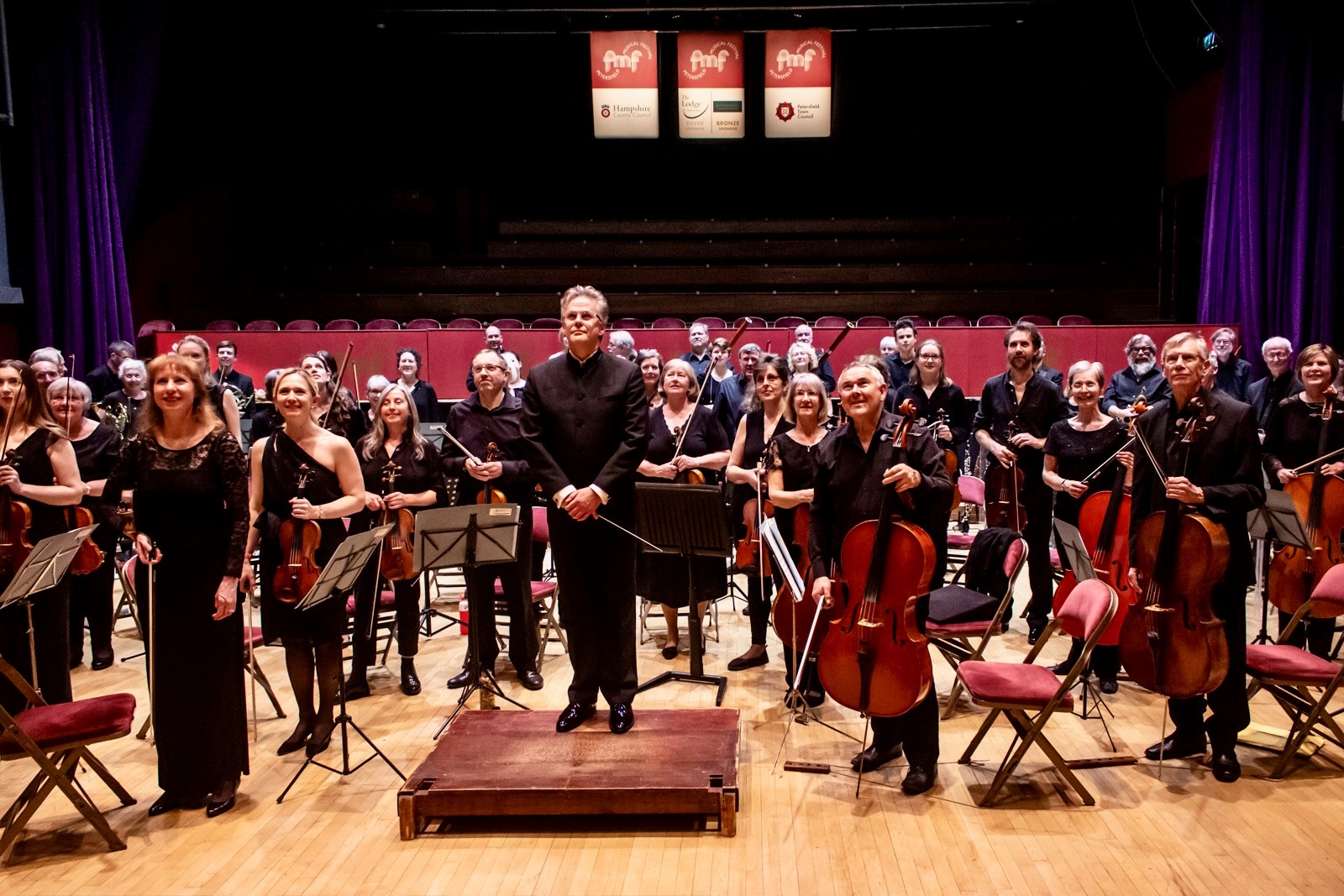
A capacity audience was treated to a blockbuster programme of orchestral music last Thursday which encompassed Beethoven’s heroic ‘Emperor’ Concerto and the mighty Symphony No.10 by Shostakovich, as part of the Petersfield Musical Festival. A full-scale symphony orchestra, including at various points triple woodwind, bass clarinet and contrabassoon, snare drum, tam-tam and xylophone, gave every ounce of energy to deliver a rousing and emotionally charged performance.
The evening started with a miniature tone poem by Russian composer Anatoly Lyadov, Baba Yaga. In a style reminiscent of the programme music of French composer Paul Dukas, the composer deployed syncopation, chromatic scales and a wide range of orchestral effects to depict the Wicked Witch of the title, based on a folk story popular in Russia and Eastern Europe. The orchestra, conducted by Robin Browning and led by Helen Purchase, successfully highlighted the colour and drama of the story as motifs were echoed around different instrument groups from whispering flutes to growling contrabassoon.
Next Ariel Lanyi, a young award winning young pianist, took to the stage for the much-loved Piano Concerto No.5 in E flat by Beethoven, so called ‘Emperor’ (although it is not clear why this epithet exists.) The bombastic opening chord with which the piece opens quickly gives way to cascades of scalic and arpeggiated passages on the piano, almost like a cadenza, which the soloist accomplished with utmost grace and delicacy. The dialogue between piano and orchestra was beautifully delineated throughout. Ariel showed an ability to lift his playing to powerful heights with firm and sure finger-work, only to drop down into hushed pianissimos which the audience clearly found spell-binding.
The famous slow (Adagio) movement, with its rising and falling chains of piano trills, was delivered masterfully. The sheer poetry of the music shone through, as Ariel employed all his powers of expression to interweave the piano lines with the lilting orchestral writing. The dominance of the piano, thematically and stylistically, however, was never in doubt (Beethoven was writing for his own instrument); Ariel threw himself into the expressive and slow melodic lines with some powerful, impassioned playing.
The slow movement segued into a playful Rondo finale which ended the Concerto on a joyous note. Long sustained calls from the horn and oboe acted as ‘pedal’ notes underpinning the musical texture as the varied and inventive episodes progressed towards the final conclusion. After his ovation, Ariel was not allowed to leave before giving the audience an encore, for which he chose Chopin’s Nocturne in C sharp minor, a moment of slow, quiet contemplation after the tempestuous Concerto.
To finish, Petersfield Orchestra rose to the challenge of Shostakovich’s massive 10th symphony. All hands were on deck to deliver this epic and sometimes angry statement of dissidence from a composer clearly at odds with the authoritarian regime of Stalin under which he lived. Of particular note were solos by bassoon, clarinet, piccolo and first violin – full marks to these members of the orchestra.
First performed shortly after Stalin’s death, the Symphony covers a gamut of musical styles and moods from tragedy and despair to anger. A haunting string introduction quickly builds to a noisy climax, only to retreat into a more introvert mood. The second movement Scherzo follows a nightmarish march rhythm, and is said to be a musical portrait of Stalin with its military overtones. The beautiful third movement is based on personal motifs and here the orchestra switched gears to express a sense of the composer’s longing in an intensely private and romantic mood.
In culmination, the full battery of percussion was let loose in a massive climax in the final Allegro. The motifs in the slow movement are re-articulated exultantly by the brass but are overlaid now by a sense of triumph and assertiveness. Conductor Robin Browning and the orchestra threw everything at this music to thrilling effect – screaming piccolos, piercing flutes, massive brass (trombones, trumpets, tuba), snare drum and tambourine all added to the colour and volume of the fortissimos. If the audience felt shattered at the end, the orchestra must have felt equally exhausted by such a sustained passionate outpouring – a test of stamina they maintained superbly right until the final notes of this invigorating display of virtuosic orchestral playing.
Sarah Hard
And another review by David Green:
Scholarship might never decipher all the meanings in the music of Dmitri Shostakovich. Maybe not everybody will agree but for me the debate’s been over for a while about the greatest composer of the C20th, opaque ironies and false signals notwithstanding. I’ve been trying my best with the forbiddingly loud, large-scale, complicated symphonies recently and the chance to hear one in the flesh at Petersfield had to be worth that bit of extra mileage.
First, though, came the short, sharp shock of Liadov’s Baba-Yaga, all drama and urgency although in the circumstances only a softening-up exercise for what was to come.
Ariel Lanyi and the orchestra then blasted into Beethoven’s Emperor Concerto, its big beginning and then the big theme of its first movement. Ariel is highly expressive in Beethoven’s grander gestures and even in the pacific moments we know he’s only brewing up the next storm. Row 3, right in front of where the sound comes out of the piano, might not be the optimum position that a recording engineer would take his settings from but, on what was not a night for faint hearts, one was almost inside the sound. One of my imagination, the orchestra, Ariel or Beethoven was conjuring torrents of rain or maybe it was all four of them.
The Adagio is a sumptuous serenade giving Ariel a chance to be lyrical and were it not obvious that it moved into a new mood and theme, you might think it was a concerto of two movements because we are suddenly in the Rondo Allegro, ever moving with Beethoven’s protracted way through the triumphant variations of what could almost be a tarantella. Precious few do heroics like he did and Ariel and the Petersfield Orchestra stood and delivered. Luckily he had an encore ready and even more luckily it was the peace and release of the lost reverie of Chopin’s Nocturne in C#minor.
But the evening was still young. It’s astonishing to think that in recent weeks Beethoven, that monster that overshadowed all that came after him, has not necessarily been the main feature of two brilliant concerts. It takes some doing to outdo him and over the whole oeuvre hardly anybody does but you get him playing away against a C20th Russian who fancies the fixture and you might just outpoint him.
The Shostakovich Symphony no. 10 begins with a 25-minute first movement of immense, searing power – woodwind, brass and all sections having their parts before the colossal work of the strings, led by the shock storm-troopers of the violins. I had no idea that the Petersfield Orchestra could make such a sound or take on this vast edifice of a work. I’m an enthusiastic, hopefully generous concert-goer and reviewer who doesn’t go to find fault and so I use up words of praise readily without throwing them about like confetti but then there’s this.
Robin Browning is somehow what Herbert Von Karajan should have been like if he hadn’t been the most appalling narcissist- distinguished, charismatic, readily in charge of an orchestra who surely have the greatest respect for him and he’s made all this possible.
The second movement is short, nasty, dense and aggressive, it being the portrait of Stalin that Shostakovich was finally able to paint. And then he signs it with his DSCH motif in every timbre, texture, tincture and atmosphere available to him in the third movement. And after the disembodied early fragments of the fourth movement, the swirling militarism leads to a great signing off with the same.
It’s as if the sound of soldiers marching, or the dereliction they leave behind them is somewhere there in so much of Shostakovich, this nervous, studious, very bravest of creative artists. I try my best to apply the most stringent of criteria before appointing anyone to the highest echelons of such heroes but I ask no questions of him. He has nothing to prove.
That was a monumental performance of an enormous work. It was exhausting to listen to so the Good Lord only knows what it was like to play in. The Petersfield Orchestra were deeply impressive in all departments and I’m not surprised they were sold out weeks in advance.
I could, at long last, end on a darkly ironic note and recommend you sign up for their next gig which is Bruckner but add that I won’t because Bruckner is much closer to my Bottom 10 Composers than my Top 10. However, I did stand for hours at the Proms to hear the Berliners do whichever one it was and came out less unimpressed than I’d anticipated so being able to sit down might improve him further.
But, no. The Petersfields, Robin, Shostakovich- and Beethoven and Ariel- absolutely delivered the goods beyond all expectation. If you’d told me there could still be days like this I’d have had my doubts but you’d have been right.