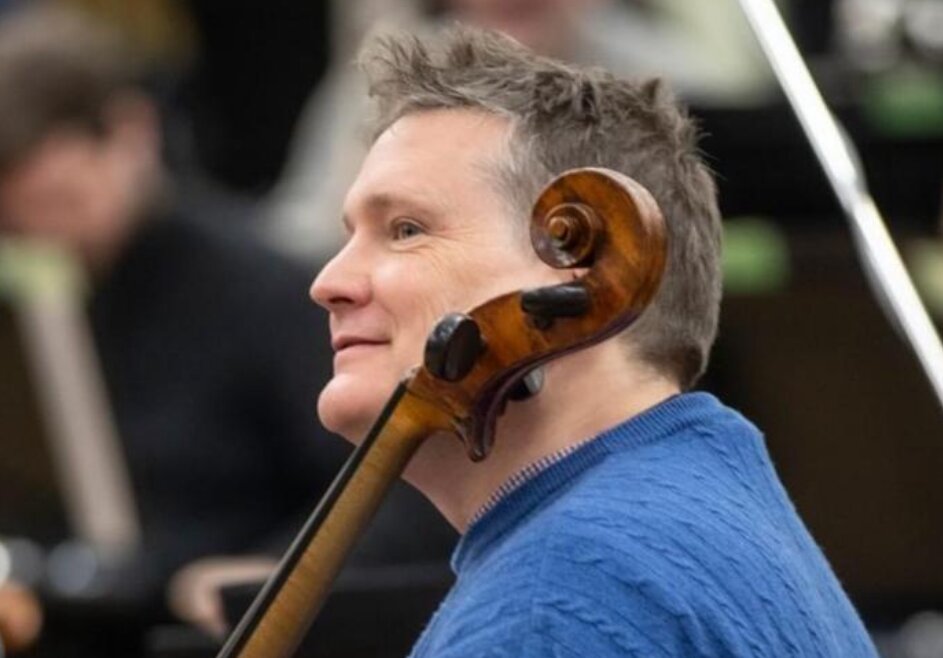
On Wednesday 11 February Cellophonics will be performing at Boxgrove Priory Church.
Cellophonics comprises cellists Christopher Allan, Adrian Bradbury, Ian Burdge and Benedict Rogerson.
Simon is in conversation with Ben.
What are you most looking forward to when performing at this concert?
I heard Yo Yo Ma recently interviewed by the American comedian and talk show host Stephen Colbert. Asked what the point of music is, he replied that “Music is energy”, and left unsaid “and energy cannot be destroyed but converted from one form to another.”
So, what I’m hoping for – for myself and for anyone we’re lucky enough have to join us – is some kind of transformation, perhaps a few moments to pack away the harsh realities, the chaos, of the outside world and re-connect with people through music.
On the face of it, Cello Quartets – a quartet of cellos – sounds pretty niche and in many ways it is! Any cellist who has had the good fortune to experience playing in Youth Orchestras will remember the revelation when, perhaps in a sectional rehearsal, they’ve whizzed through the official repertoire, and their coach brings out some ensemble pieces for them to play together. It’s a miracle.
Historically there has been a plethora of music written for cello ensemble, much of it by 19th Century and early 20th Century virtuosi, such as Julius Klengel, Alfredo Piatti or Tchaikovsky’s cellist Wilhelm Fitzenhagen. Most cello ensemble concerts will feature performances of arrangements, in other words, music not specifically written with cellos in mind. This is great, because the cello – an instrument that most closely reflects the human voice – is so versatile, and easily lends itself to such things.
What we’ve been trying to do, which is a bit different, is bring this medium into the 2020s by asking composers to write especially for us.
Through my day job with the BBC Concert Orchestra, I’m surrounded, luckily, by “good people”. Amongst our composers we have Guy Barker, Rod Elms, Julia Simpson, Colin Alexander, Rowland Sutherland and my friend Simon Baggs, who, as it turns out is a bit of a polymath.
Simon is a violinist; he played on Phantom of the Opera for around 18 years, and before that, was member of the Royal Philharmonic Orchestra. Along with the whole cast and band of the show, during lockdown he was made redundant- but, phoenix-like, he has turned it into a great thing. Since then he’s turned his hand to all sorts of things…he’s a painter (as in paintings, rather than walls) a writer – of books (rather than lyrics, I think), and of music, conducting, (orchestras rather than buses), and of course he’s still primarily a violinist, but if you live near him there’s a strong chance he looks after your garden. One might notice a propensity of perfectly chequered lawns as one drives through Surbiton these days.
I bumped into him in the pub we had independently chosen to warm up in before going to hear Adrian Bradbury, one of the cellists, play the Walton Concerto. Simon happened to mention that recently he had been writing, by which I thought he meant a book, but actually, no, he’d been composing music.
So I said, “well, you’re going to have to write a cello quartet.” I didn’t think much of it until a few months later, when he sent me a little recording of eight bars that he’d played on a keyboard. We had a concert in two weeks so rang him back quick as a flash. “Look,” I said, “this might be insane, but going with Bernstein’s maxim that ‘to achieve great things requires two ingredients: first, a really good idea and second, not quite enough time.’ You’ve had the good idea, and I can give you not quite enough time!” Anyway, he achieved it. I have a hunch that his piece is going to be a Classic FM hit. It’s my son’s favourite piece that we play, an absolute jewel.
We also have some old gems, including a suite by York Bowen, “The English Rachmaninov”, which was completely lost to the world, largely because it was hidden in a pile of my grandfather’s (also a cellist) music.
Apart from the music, I’m simply looking forward to seeing everyone. As a quartet we’re basically really good friends. Ian, Chris and I were students at the same time, but at different establishments. We all work in different wings of the profession, and come together to remind ourselves of how we fell in love with music in the first place.
So what can people expect when they come to Boxgrove?
A completely different take on the instrument, because it’s unusual to have four cellos and nothing else. In one of our first concerts, at the Whinburgh Festival in Norfolk, the audience were worried that everything was going to sound a bit the same, and were quite taken aback when it wasn’t.
The thing is, rather like the saying “it’s the people that make a place”, we’re all very different players, and personalities.
The programme has been carefully crafted: every piece is very different. How can you go to Boxgrove and not tip your hat to the Tudors and choral singing? So we will play William Byrd’s Ave Verum, which shows the cello’s singing quality, and a couple of incredible Fantasias by Henry Purcell. They are mind blowing and absolutely could have been written today. In the tiny chapel in St Blaise’s, there is graffiti on the wall dating back to 1632. The bored young fellow who used his penknife to such effect, his initials are “RI”, would have crossed the lives of both composers – the end of Byrd’s and the beginning of Purcell’s.
Bill Thorpe was the first person I ever asked to write for Cellophonics. In Puccini’s opera Tosca, there’s a classic moment near the beginning of Act Three, where Cavaradossi, in his prison cell, has been sentenced to death. The priest comes around offering to read his Last Rites, but Cavaradossi says, “actually, no, but I would like a pen and paper.” So, he fetched him a pen (or a quill?) and Cavaradossi starts writing his farewell love letter to Tosca, and whilst he’s writing, a quartet of cellos takes over the music. So we’re his internal thoughts. It’s a beautiful, amazing thing, and quite a big deal as a cellist, when you get to play it.
Bill has written us a medley of Puccini’s opera hits using, as a corner stone, this moment from Tosca.
Guy Barker first became well known as a jazz trumpeter and when I joined the BBCCO (14 years ago!!) he was our Composer-in-Residence. He is very charismatic and a great raconteur. One morning, we had both arrived early for an orchestral rehearsal at Alexandra Palace. I mustered up the courage to ask him if he’d consider writing a cello quartet – he thought I meant for a rhythm section – so piano, drums and bass- and cello!! It dawned on me, as I sat there in the rehearsal, that this would need clarification at the break!
Guy set about it during lockdown, and it’s one of our favourite pieces. It’s based on two trains: a slow train called the Big Ugly, and a fast one called the Altoona Express. He called it Wood on the Tracks after the Bob Dylan album Blood on Tracks, and I think that’s going to become the title of our CD which we recorded in November at the Menuhin Hall for Somm Records.
About Cellophonics
Champions of all things Cello, the Cellophonics are Christopher Allan, Adrian Bradbury, Ian Burdge and Ben Rogerson. They explore music for cello quartet and have been expanding the repertoire with a growing list of exciting new works. Their performances brim with warmth and sparkle with virtuosity, bringing to life the contrasting characteristics of the cello. From the operatic tones of Puccini’s Tosca to the driving rhythms of jazz lord Guy Barker’s especially commissioned Wood on the Tracks. With a myriad of stops along the way, their eclectic musical journey is something for everyone.
About Ben
Cellist Ben Rogerson is a member of the BBC Concert Orchestra and the London Mozart Players.
He spent the Noughties with the Irish Chamber Orchestra giving concerts with artists such as Maxim Vengerov, Anthony Marwood and Nigel Kennedy in venues ranging from Carnegie Hall in New York to the Forbidden Palace in Beijing, and the Community Centre on Inis Boffin.
His life with the BBCCO involves a more eclectic range of music making, from classical and pop concerts, to recording music for TV, film, radio and CD. Earth Wind and Fire, Kylie Minogue, and Dame Edna Everidge are amongst the artists they have worked with recently, and the orchestra is resident for Radio 3’s flagship show “Friday Night is Music Night”.
Ben loves appearing as a guest with the Academy of St. Martin-in the-Fields, Britten Sinfonia and the English Chamber Orchestra and gives chamber music concerts with the Minerva Ensemble and Ferrer Quartet.
Solo projects have included Shostakovich’s Cello Concerto No1 with Richard Hickox, and Haydn’s C Major Concerto under the baton of David Watkin, both at the Endellion Festival in Cornwall.
Ben studied at the Royal Academy of Music where his cello teacher was Derek Simpson of the Aeolian Quartet, and at SUNY Purchase, USA, with Julia Lichten of the Orpheus Chamber Orchestra.
For several years Ben coached the cello section of the National Youth Orchestra of Ireland, a role he has also fulfilled for the National Youth Orchestras of Wales, and of Great Britain, and the Royal Academy of Music. He teaches the cello at Tonbridge School and the Royal Grammar School in Guildford.