The Cathedral’s musical activities rely entirely on the generosity of its supporters. The aim of the Chichester Cathedral Platinum Endowment Trust for Music (CCPETM) is to help ensure that the tradition of fine music-making endures.
The CCPETM has an initial target of £5m by 31 March, which it has nearly achieved. Funds received by that date (and possibly beyond then) will be generously match-funded by two anonymous donors. But it needs to raise more than double that amount so as to ensure the long-term viability of music. Funds are needed to cover the salaries for the organists and lay vicars, as well as funds for the organ scholarship and choral scholarships. A £10m investment would generate enough interest to fund all these activities.
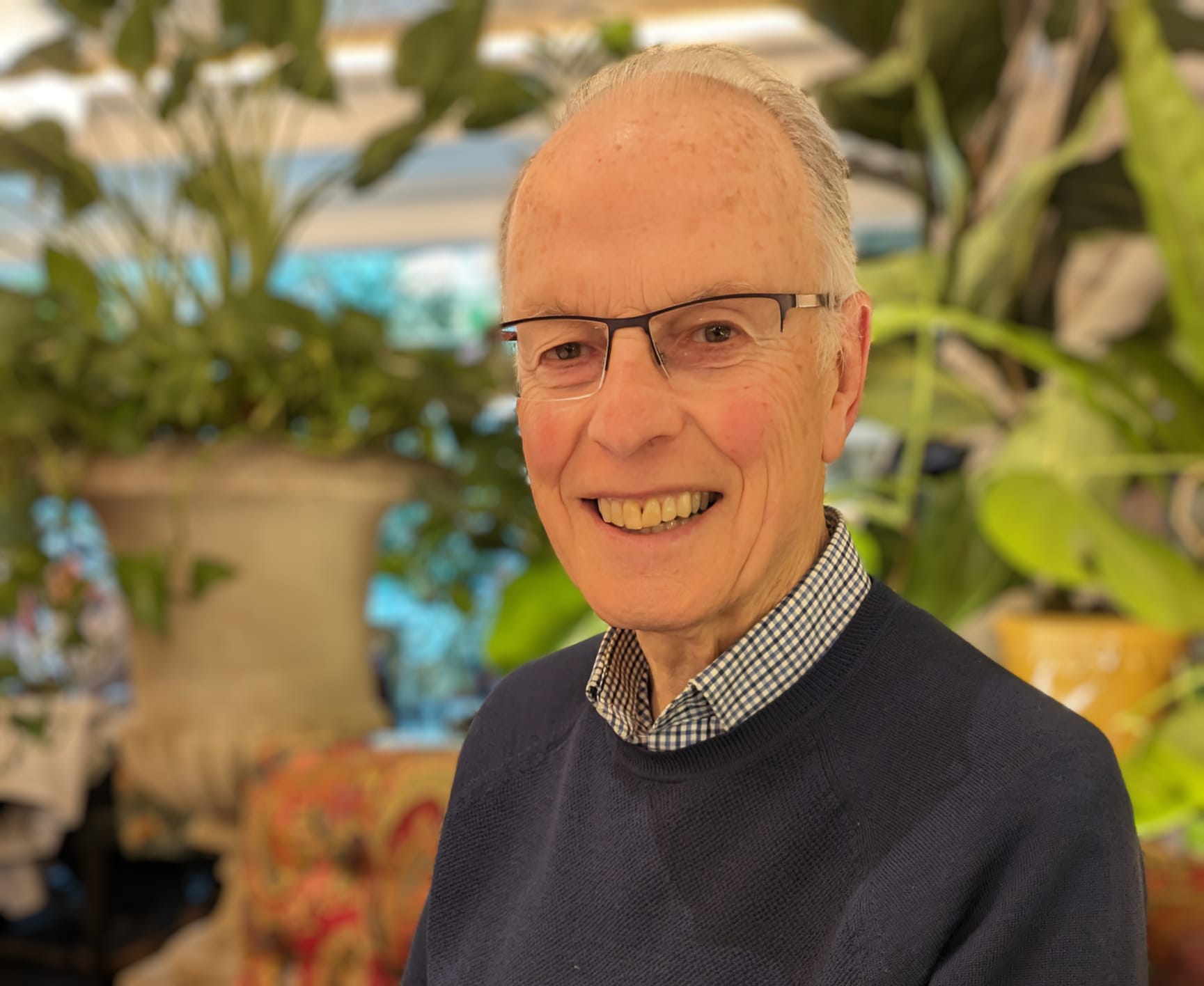
Noel is part of a small group focusing on raising funds to support music in Chichester Cathedral.
Simon is in conversation with Noel.
I think it’s absolutely crucial that these cathedral foundations survive. Not just because of the institutions themselves. Just consider those choristers who have turned out to be brilliant musicians not just in this country but in the world – Christopher Hogwood, David Munrow, John Eliot Gardiner, Simon Standage, Simon Carrington, David Atherton and Bob Chilcott, for example.
Suddenly a child aged eight or so sings in Latin, French or English, or sings the Psalms, which is not easy, and reads music. It’s a wonderful experience for them, and they simply soak up so much, like blotting paper. Choral singing does so much particularly for younger people in terms of the discipline and teamwork, and the music gives so many people so much pleasure.
One of the vice-presidents of CCPETM is Rachel Portman, a composer best known for her film music. She’s now suddenly moved into choral music, and in fact one of her recent works was the commission for BBC Radio 3’s carol service from King’s on Christmas Eve. We’re putting on a fundraising concert in the Cathedral on 21 November where the cathedral choir is singing some of her choral music. That’s definitely going to be a special event.
Who and/or what have been the most important influences on your musical career or interest in music?
I went pretty much straight into the chapel choir at Christ’s Hospital and then went on to Jesus College Cambridge to read Classics, but I also got a choral scholarship, which committed me to singing in the chapel. It was a wonderful time to be at Cambridge if one wanted to mix with talented musicians and especially singers.
In those days, there wasn’t anyone in Cambridge who gave singing lessons, so I travelled to London to learn from David Franklin, a giant of a man, and principal bass at Covent Garden, Glyndebourne and Salzburg. I started conducting as an undergraduate. I ran the Guy’s Hospital Nurses Choir in London on those days when I came to London for my singing lessons. That was a coup, as I was able to combine the female voices with the male voices of my Cambridge college choir. Simon Preston and Philip Ledger helped me create innovative choral programmes.
I never actually wanted to be obliged to make my living from music, but I wanted to be in the music world. Having had a go at teaching, I was headhunted into a job as archivist and subsequently went into publishing. Having moved to Chichester, I joined the Cathedral Choir, which I loved, and then when the family came along, I left the Cathedral Choir on a full-time basis and became a deputy, and almost immediately I was deputising at Winchester and Salisbury and Chichester, so I was singing at all three Cathedrals. I also set up the St Richard Singers. So I had a very full musical life on top of my day job.
Are there any composers for whom you feel a particular affinity?
I love Brahms’ and Schubert’s choral music and songs which I worked on in depth with my singing teacher. The Brahms Requiem is one of my favourite works. He dedicated it to the memory of his mother, and I conducted a performance in Chichester Cathedral to mark my mother’s passing in 2004.
I like Tudor and Baroque music, Bach’s Passions, Mozart and Richard Strauss’ songs and operas. I have done a lot of Benjamin Britten. I used to run a consort called Close Harmony, which was the lay clerks and lay vicars of the Cathedral plus three sopranos, and we gave the first performance of Benjamin Britten’s Sacred and Profane, which is a song cycle, which is virtually unsingable, to be honest. It’s not one of his great works, but I simply love his work. And we’ve sung works like Hymn to St. Cecilia loads of times.
What are your most memorable experiences, either as a performer, composer or listener?
As Close Harmony we were singing Britten’s Rejoice in the Lamb in the church of St Mary Abbot’s Kensington, where the priest in charge was a man rejoicing in the name of Anthony Caesar. The work includes a reference to a cat called Geoffrey, and at which moment when we were singing it Anthony Caesar’s cat came out and wound itself in and out of the singers as we were performing. We just about held it all together that time! I’m also proud to have conducted my first symphony (Schubert 5) with a professional orchestra well north of 80 years old!
What advice would you give to those who are considering a career in music?
If you’ve got sufficient passion, then go for it, but be prepared not to be able to make a living at it. One example of such passion is Robert Tear, a tenor, who was a contemporary of mine in Cambridge, who had the drive, personality and presentation to get himself right to the top as a soloist. He avoided going down the usual route of joining as many choirs as one could and hoping to get noticed. There are lots of people who might have had a voice as good as his but hadn’t got the other necessary attributes.
How would you define success as a musician?
I find it hard to think about actually succeeding! So often one remembers the lack of success rather than the sort of things that went so well that everybody loved it. But I suppose you are successful if your peers acknowledge that.
About Noel
Noel has been singing for much of his life. His long-forgotten Away in a manger (Wandsworth 1947) was followed by his Once in Royal David’s city (Horsham 1952), whose transmission the BBC restricted to the Antipodes.
Education at Christ’s Hospital led to a choral scholarship at Jesus College, Cambridge, where he studied singing with David Franklin and formed the Aeolian Consort of Voices (later Close Harmony), which toured with the organist Simon Preston.
After Cambridge he sang in Chichester Cathedral Choir under John Birch for 15 years, involving the daily liturgy, concerts and first performances of works by, among others, William Walton, Herbert Howells, Lennox Berkeley, William Albright and, most notably, Leonard Bernstein with the premiere of his Chichester Psalms in 1965.
In tandem with his work as a publisher, he became a regular deputy in three cathedral choirs — Winchester, Salisbury and Chichester — taking part in their services, overseas tours and recordings, memorably the razzmatazz around the premières of Andrew Lloyd Webber’s Requiem, with Lorin Maazel, Sarah Brightman and Placido Domingo.
In Chichester he founded an amateur chamber choir, the St Richard Singers, and with them directed many of the major works of the choral repertoire, including
J. S. Bach’s St John and St Matthew Passions, Handel’s Messiah, the Requiems of Brahms, Duruflé, Fauré, Mozart and Rutter, Masses by Byrd, Mozart, Rossini, Schubert (with the Hanover Band), and Vaughan Williams, the Vespers of Monteverdi, Mozart and Rachmaninov, Purcell’s Dido and Aeneas, and Vivaldi’s Gloria (with the Hanover Band).
Noel has been associated with the Hanover Band for more than ten years and has helped it to develop both its relationship with the Stationers’ Company, and its presence in the City of London, as artistic director of ‘Beethoven in the City’ (2020) and ‘Schubert in the City’ (2022/23). For many years he has been artistic director of the St Ceciliatide Festival at Stationers’ Hall.
Read “The Chichester Psalms: A Chorister Reunion Captured by BBC South Today“
Read “Memories of Leonard Bernstein’s Chichester Psalms on 60th anniversary“
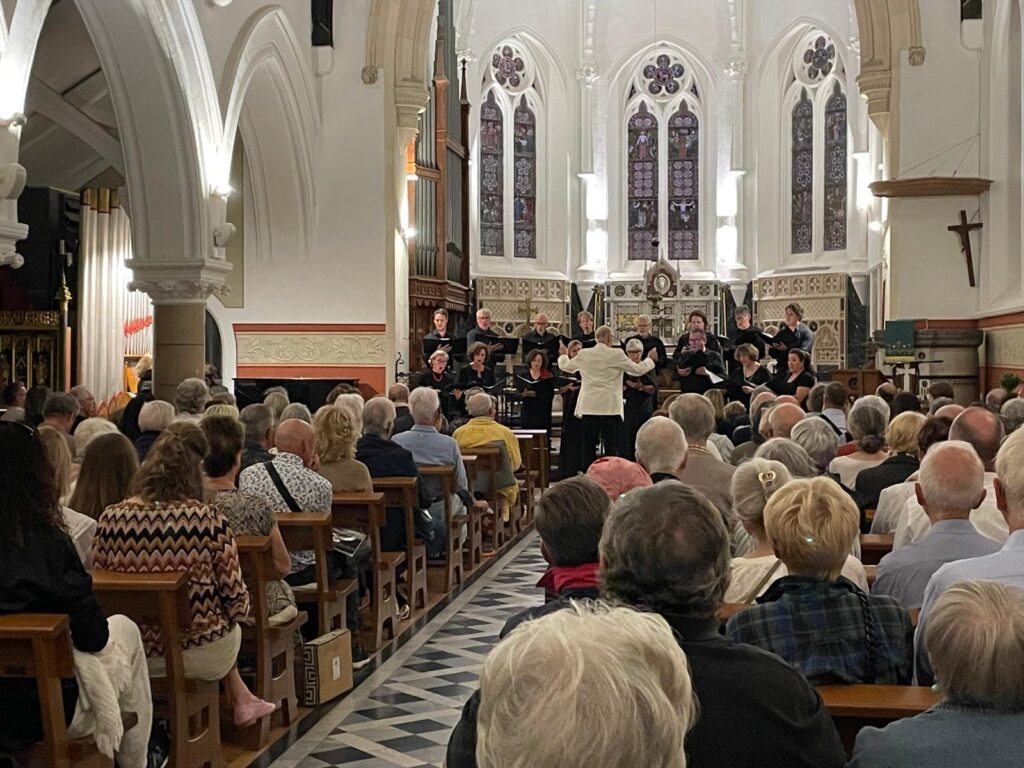
Noel conducting the Ensemble Gabriel Fauré in Menton, Alpes Maritimes